Targeted metabolite quantification is required when biomarker candidates, pathway intermediates, hormones, drug metabolites, or other predefined compounds must be compared across samples using concentration-based endpoints. In plasma, serum, urine, and tissue extracts, however, low-abundance targets can be obscured by co-eluting matrix components, structurally related compounds, and analytes spanning a wide concentration range. Detecting a peak at the expected m/z is therefore only the starting point; a useful assay must establish analyte identity, control background and matrix-related variability, and produce a response that can be calibrated and reproduced.
Triple quadrupole LC-MS/MS is designed for this type of measurement, which is why it remains a benchmark for targeted quantification. By monitoring predefined precursor-to-product ion transitions, it concentrates acquisition on known targets and combines high selectivity with efficient multiplexing. This article introduces the fundamental architecture, targeted acquisition modes, core analytical advantages, and major application scenarios of triple quadrupole mass spectrometry.
1. Triple Quadrupole MS Fundamentals
A triple quadrupole instrument performs precursor selection, collision-induced fragmentation, and product-ion selection in sequence. Q1 and Q3 are the mass-selective stages; Q2 serves mainly as the collision cell.
1.1 Q1, Q2, and Q3 Perform Distinct Analytical Functions
Ions generated by electrospray ionization (ESI) or another atmospheric-pressure ionization source enter Q1, the first mass-selective quadrupole. Radiofrequency and direct-current voltages are adjusted so that ions within the selected precursor m/z window have stable trajectories through Q1, while many other ions are rejected. The isolated precursor then enters Q2, which is typically operated as an RF-only collision cell containing a collision gas for collision-induced dissociation (CID). The resulting fragment-ion population enters Q3, where a predefined product ion is selected before the transmitted signal reaches the detector.
The notation QqQ makes this division explicit: Q1 and Q3 are mass-selective, whereas the lowercase q denotes the RF-only collision cell. The more familiar QQQ shorthand is used elsewhere in this article. In practical terms, Q1 selects the expected precursor m/z window, Q2 generates fragments, and Q3 transmits the chosen product ion (Murray et al., 2013; Tsakalof et al., 2024).
1.2 From a Single m/z to a Precursor-to-Product Ion Transition
Single-stage selected-ion monitoring records the abundance of an ion at a chosen m/z. In selected reaction monitoring (SRM), an m/z-selected precursor is fragmented and one or more predefined product ions are recorded. A specific precursor/product pair—for example, 300.2 → 184.1—is termed a transition (Murray et al., 2013).
This is more selective than monitoring precursor m/z alone. An interferent must pass the Q1 window and yield the monitored product ion under the chosen collision conditions. A transition is therefore a constrained analytical channel, although it is not a unique molecular fingerprint in every matrix.
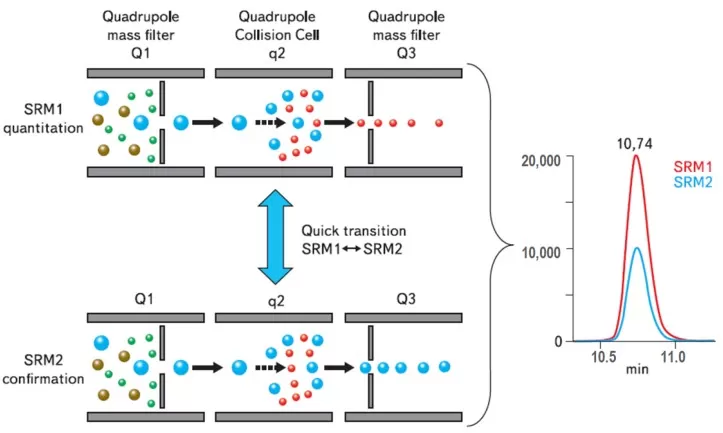
Figure 1. Triple quadrupole MS in MRM mode. Q1 selects the precursor ion, Q2, the lowercase q in QqQ notation, performs CID, and Q3 selects product ions. Quantitation and confirmation transitions generate coincident chromatographic peaks. Reproduced from Figure 3 in Tsakalof et al. (2024), Molecules, under CC BY 4.0; resized, with no content changes.
2. SRM and MRM Acquisition: Single-Transition and Multiplexed Monitoring
After transitions are defined, the instrument cycles through the corresponding Q1 and Q3 settings while analytes elute from the LC column. Each transition produces a chromatographic trace that can be checked at the expected retention time and integrated for quantification.
2.1 SRM: Monitoring a Defined Precursor-to-Product Transition
Consider an analyte monitored through the transition 300.2 → 184.1. Q1 transmits the precursor at m/z 300.2, Q2 fragments it at an optimized collision energy, Q3 transmits the product ion at m/z 184.1, and the detector records the ion current. Repeating this sequence across the chromatographic peak produces an SRM trace whose integrated peak area is the analytical response.
The peak should appear at the expected retention time and be integrated using predefined rules. Its area is the analytical response; Section 4 explains how calibration converts that response into concentration.
2.2 MRM: Multiplexing Predefined Transitions
Multiple reaction monitoring cycles through many predefined precursor-to-product pairs within one LC-MS/MS acquisition. These pairs may represent different analytes, several product ions from one analyte, an analyte and its internal standard, or quantifier and qualifier transitions where the method uses them. A quantifier transition supplies the primary response, while qualifier transitions and validated ion ratios can provide additional evidence against interference.
Terminology varies across platforms and laboratories. IUPAC describes SRM as recording selected product ions from m/z-selected precursor ions and MRM as applying SRM to multiple product ions from one or more precursor ions. In routine usage, SRM often denotes one defined transition and MRM a multiplexed set of transitions; the actual acquisition design should therefore be stated explicitly (Murray et al., 2013).
2.3 Dwell Time, Cycle Time, and Scheduled MRM
Adding transitions has a cost. As more channels are monitored at the same time, dwell time per transition can fall, cycle time can lengthen, and narrow peaks may be sampled too sparsely. Scheduled or dynamic MRM reduces this pressure by collecting each transition only within an expected retention-time window. High-throughput studies show that retention-time scheduling and dwell-time weighting can expand coverage compared with unscheduled MRM, provided that co-elution, peak width, and the number of points across each peak remain under control (Bhaskar et al., 2022; Wang et al., 2022).
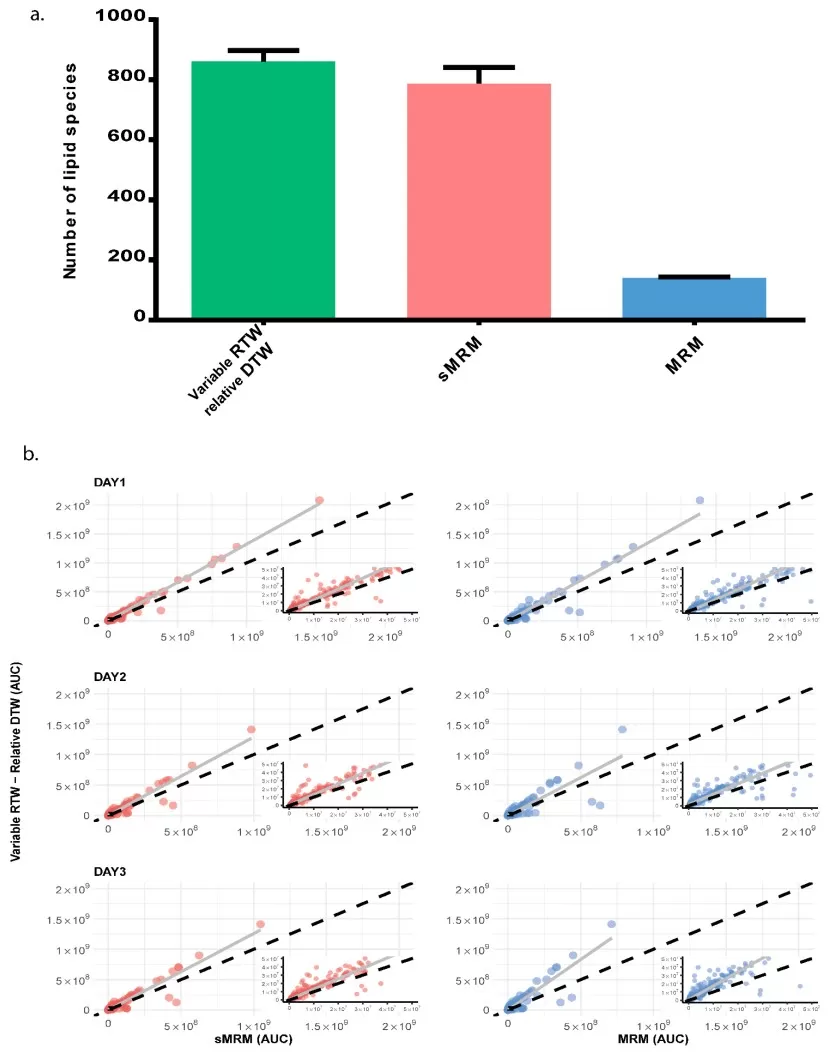
Figure 2. Scheduled MRM and dwell-time weighting in a multiplexed lipidomics assay. Panel (a) compares lipid coverage, and panel (b) compares extracted-ion chromatogram AUC values across three analytical days. Reproduced from Figure 1 in Bhaskar et al. (2022), Biomolecules, under CC BY 4.0; resized, with no content changes.
3. How Triple Quadrupole LC-MS/MS Achieves Selectivity and Quantitative Sensitivity
Each stage narrows the pool of ions that can reach the detector. This layered filtering is the main source of triple quadrupole selectivity and helps low-level peaks stand out from a complex background.
3.1 Transition-Level Selectivity and Interference Rejection
To appear in a target MRM trace, an unrelated compound would generally need to pass the Q1 precursor window, generate the right fragment under the selected collision conditions, pass the Q3 product-ion window, and elute in the target retention-time region. Most background ions fail at least one of these conditions, which is why triple quadrupole MS can sharply reduce chemical and spectral interference in complex samples (Tsakalof et al., 2024).
Even with two mass filters, a transition is not always unique to one analyte. Isobaric compounds, in-source fragments, metabolites, and structural isomers can share transitions, so retention time, peak shape, qualifier-ion evidence, and agreement with an authentic reference standard should be evaluated together.
3.2 Cleaner Background Improves Practical Quantitative Sensitivity
The low-level performance of triple quadrupole MS comes mainly from rejecting unrelated signal in the recorded channel and concentrating acquisition time on predefined transitions—not from producing more ions at the source. The cleaner trace can improve practical signal-to-noise, make peak integration more stable, and lower the fit-for-purpose quantification limit for a well-behaved analyte (Tsakalof et al., 2024).
That advantage has limits. Ionization efficiency, precursor transmission, fragmentation yield, collision energy, dwell time, chromatographic peak shape, sample recovery, and detector noise still set the practical sensitivity. Poor ionization or instability cannot be rescued simply by adding an analyte to an MRM panel.
3.3 Chromatography Provides Orthogonal Selectivity
Closely related compounds may share the same nominal precursor, similar fragmentation pathways, or even the same monitored transition. Liquid chromatography separates compounds before ionization, provides retention time as an additional identification dimension, and reduces the risk that a co-eluting interferent is integrated as the target. Validated oxysterol assays illustrate why chromatographic resolution and ion-ratio checks remain important when endogenous analytes are both low in concentration and structurally similar (Rojas et al., 2023).
MRM selectivity complements chromatography; it does not replace it. Difficult isomers may require stronger chromatographic separation, derivatization, ion mobility, or another source of orthogonal selectivity.
3.4 Matrix Effects Occur Before Mass Selection
Mass-spectral interference and ionization matrix effects are related but distinct problems. Q1 and Q3 can exclude many unwanted ions after they have formed, but co-eluting phospholipids, salts, and other matrix components may suppress or enhance analyte ionization in the source before the ions reach Q1 (Matuszewski et al., 2003). The mass filters cannot restore signal that was lost during droplet formation and desolvation.
Triple quadrupole LC-MS/MS therefore removes many mass-spectral interferences but remains vulnerable to source-level matrix effects. Sample cleanup, chromatographic optimization, dilution where appropriate, matrix-effect experiments, and suitable internal standards are still needed.
4. Absolute Quantification Methods Using Triple Quadrupole LC-MS/MS
SRM and MRM provide selective responses, not concentrations. To report an absolute value, the assay must link response to known standards and show that the relationship holds in the intended matrix and concentration range.
4.1 Reference Standards and Calibration Curves
Calibration standards prepared from authentic, well-characterized reference material establish the concentration-response relationship. Many assays calibrate the analyte-to-internal-standard peak-area ratio rather than raw analyte area. Sample responses should be interpolated only within the validated range.
Endogenous metabolites complicate calibration because a truly analyte-free biological matrix may not exist. Depending on the matrix and analytical objective, the method may use matrix-matched standards, a scientifically justified surrogate matrix, or another validated strategy. The model must represent study-sample behavior, not simply fit the calibrator points. Calibration is the step that converts MRM response into a concentration estimate (International Council for Harmonisation, 2022).
4.2 Internal Standards and Stable-Isotope Dilution
An internal standard works best when it is added early enough to pass through the same extraction, handling, injection, chromatography, and ionization steps as the analyte. The analyte-to-internal-standard ratio can then correct part of the variability introduced by sample preparation, injection volume, source fluctuations, and matrix-dependent response changes.
A stable-isotope-labeled analogue is usually the closest match and is recommended when feasible. Isotope purity, possible unlabeled-analyte contribution, isotope exchange, and chromatographic behavior still need evaluation. When an analyte-specific labeled standard is unavailable, another suitable internal standard may be used, but its ability to correct recovery and matrix effects should be demonstrated for the assay (International Council for Harmonisation, 2022).
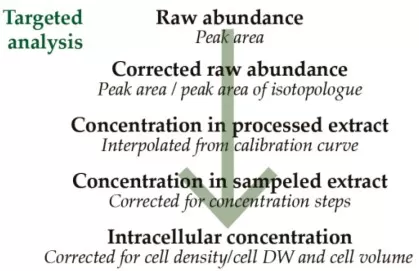
Figure 3. Workflow for absolute intracellular metabolite quantification. Peak area is corrected with an isotope-labeled internal standard, converted by calibration, and normalized using cell density or dry weight and cell volume. Adapted from Figure 1b in Røst et al. (2020), Metabolites, under CC BY 4.0; cropped and resized, with no scientific content changes.
4.3 Fit-for-Purpose Method Validation
A quantitative method must show that it performs acceptably in its intended matrix, concentration range, and decision context. Typical checks include selectivity and, where relevant, specificity; matrix effects; calibration range and quantification limits; within-run and between-run accuracy and precision; carryover; stability; and dilution integrity. Recovery, robustness, and reinjection performance may also be important. ICH M10 provides a formal framework for regulatory bioanalysis, while exploratory metabolomics should use a fit-for-purpose plan matched to the claims being made (International Council for Harmonisation, 2022).
In practice, the mass spectrometer is only one part of the assay. Calibration, internal-standard correction, quality control, and validation determine whether the final concentration can be trusted.
5. When Triple Quadrupole MS Is—and Is Not—the Right Platform
Platform choice becomes clearer by asking three questions: Are the targets already known? Is concentration the endpoint? Must the assay perform consistently across a large sample set?
5.1 A Decision Framework for Targeted Quantification
Triple quadrupole MS is a strong match after candidate biomarkers or pathway metabolites have been prioritized and the next step is verification or quantitative deployment. It is usually not the first choice for unexpected-compound discovery or information-rich structural work.
Table 1. Selecting Triple Quadrupole MS for Targeted Quantification: Best-Fit Scenarios and Key Limitations
| Study objective / scenario | Platform fit | Why triple quadrupole MS fits | Key limitation |
|---|---|---|---|
| Predefined low-abundance analyte quantification | Strong fit | Transition-focused acquisition supports selective, reproducible low-level measurement. | Matrix effects, sample preparation, and chromatographic interference still require control. |
| Absolute quantification using reference standards | Strong fit | Calibration and internal-standard correction support defensible concentration estimates. | Requires appropriate reference materials, a justified calibration model and range, quality control, and validation. |
| Large predefined targeted panels | Strong fit after optimization | MRM enables multiplexed monitoring of many predefined targets. | Dwell time, cycle time, retention windows, and points across each chromatographic peak must be balanced. |
| Unknown discovery or broad structural characterization | Usually not the first choice | Triple quadrupole MS is optimized for predefined transitions rather than information-rich unknown screening. | HRMS is generally better suited to accurate-mass discovery and retrospective interrogation. |
| Closely related isomers or shared transitions | Conditional or complementary fit | Triple quadrupole MS remains useful when separation and transition optimization are adequate. | Chromatography, derivatization, ion mobility, or another source of orthogonal selectivity may be essential. |
5.2 Where HRMS and Other Orthogonal Approaches Add Value
High-resolution mass spectrometry is generally better suited to broad discovery, accurate-mass feature detection, formula constraints, retrospective interrogation, and unexpected-metabolite screening (Tsakalof et al., 2024). High-resolution fragmentation data can then guide triple quadrupole MRM transition development for targeted verification (Schwaiger-Haber et al., 2021).
The two platforms therefore fit different parts of the workflow: triple quadrupole MS concentrates measurement time on predefined channels, whereas HRMS preserves broader spectral information. Difficult isomers may still require stronger chromatography, derivatization, ion mobility, or other orthogonal evidence. Absolute quantification on either platform depends on suitable standards, calibration, quality control, and fit-for-purpose validation.
6. Targeted Quantitative Metabolomics with MetwareBio
For projects that have reached the targeted-quantification stage, MetwareBio supports central metabolic pathways and metabolite classes such as bile acids, steroid hormones, neurotransmitters, oxylipins, amino acids, organic acids, and fatty acids. Assay design can be matched to the sample matrix, target list, expected concentration range, and reporting endpoint.
Researchers planning quantitative analysis of predefined metabolites can explore MetwareBio Targeted Metabolomics Services and discuss an analytical strategy matched to their project.
Frequently Asked Questions About Triple Quadrupole MS
What Is the Difference Between SRM and MRM?
SRM records selected product ions from m/z-selected precursor ions; MRM applies the same approach to multiple product ions from one or more precursors. In routine laboratory use, SRM often refers to one transition and MRM to a multiplexed set, so the acquisition design should be stated explicitly (Murray et al., 2013).
Does MRM Automatically Provide Absolute Quantification?
No. MRM measures a selective signal. Turning that signal into concentration requires reference standards, an appropriate calibration model and range, suitable internal-standard correction, quality-control samples, and fit-for-purpose validation.
Does Triple Quadrupole MS Eliminate Matrix Effects?
No. Q1/Q3 filtering removes many interferences after ionization, but ion suppression or enhancement can occur earlier in the source. Sample preparation, chromatography, matrix-effect assessment, and appropriate internal-standard and calibration strategies are still required.
Read More: Mass Spectrometry Platforms and Targeted Quantification Strategies
These articles expand on the instruments, ionization methods, and analytical strategies that surround triple quadrupole LC-MS/MS—from platform comparisons and acquisition-mode guides to data processing workflows for targeted metabolomics.
Compare leading mass spectrometry platforms side by side—understanding their strengths and limitations helps you choose the right instrument for your targeted quantification or discovery project.
Learn how LC-MS and GC-MS differ in ionization, separation, and application scope—the same chromatographic principles that underpin triple quadrupole LC-MS/MS targeted assays.
Explore how PRM on high-resolution instruments compares to MRM on triple quadrupole platforms, and when each approach is the better fit for targeted quantification workflows.
ESI is the most common ionization source for triple quadrupole LC-MS/MS. Understand its principles and limitations, including how source-level matrix effects arise before mass selection.
Understand where triple quadrupole targeted quantification fits in the broader metabolomics landscape, and how it complements untargeted discovery and widely-targeted screening strategies.
After MRM data acquisition, peak integration, calibration, and normalization determine the quality of your quantitative results. Review key data processing steps for targeted metabolomics.
References
- Bhaskar, A. K., Naushin, S., Ray, A., Singh, P., Raj, A., Pradhan, S., Adlakha, K., Siddiqua, T. J., Malakar, D., Dash, D., & Sengupta, S. (2022). A high throughput lipidomics method using scheduled multiple reaction monitoring. Biomolecules, 12(5), 709. https://doi.org/10.3390/biom12050709
- International Council for Harmonisation. (2022). ICH M10: Bioanalytical method validation and study sample analysis (Final version, adopted 24 May 2022). https://database.ich.org/sites/default/files/M10_Guideline_Step4_2022_0524.pdf
- Matuszewski, B. K., Constanzer, M. L., & Chavez-Eng, C. M. (2003). Strategies for the assessment of matrix effect in quantitative bioanalytical methods based on HPLC-MS/MS. Analytical Chemistry, 75(13), 3019–3030. https://doi.org/10.1021/ac020361s
- Murray, K. K., Boyd, R. K., Eberlin, M. N., Langley, G. J., Li, L., & Naito, Y. (2013). Definitions of terms relating to mass spectrometry (IUPAC Recommendations 2013). Pure and Applied Chemistry, 85(7), 1515–1609. https://doi.org/10.1351/PAC-REC-06-04-06
- Rojas, D., Benachenhou, S., Laroui, A., Abdourahim Aden, A., Abolghasemi, A., Galarneau, L., Irakoze, T. J., Plantefeve, R., Bouhour, S., Toupin, A., Corbin, F., Fink, G., Mallet, P.-L., & Çaku, A. (2023). Development and validation of a liquid chromatography-tandem mass spectrometry assay to quantify plasma 24(S)-hydroxycholesterol and 27-hydroxycholesterol: A new approach integrating the concept of ion ratio. The Journal of Steroid Biochemistry and Molecular Biology, 235, 106408. https://doi.org/10.1016/j.jsbmb.2023.106408
- Røst, L. M., Brekke Thorfinnsdottir, L., Kumar, K., Fuchino, K., Eide Langørgen, I., Bartosova, Z., Kristiansen, K. A., & Bruheim, P. (2020). Absolute quantification of the central carbon metabolome in eight commonly applied prokaryotic and eukaryotic model systems. Metabolites, 10(2), 74. https://doi.org/10.3390/metabo10020074
- Schwaiger-Haber, M., Stancliffe, E., Arends, V., Thyagarajan, B., Sindelar, M., & Patti, G. J. (2021). A workflow to perform targeted metabolomics at the untargeted scale on a triple quadrupole mass spectrometer. ACS Measurement Science Au, 1(1), 35–45. https://doi.org/10.1021/acsmeasuresciau.1c00007
- Tsakalof, A., Sysoev, A. A., Vyatkina, K. V., Eganov, A. A., Eroshchenko, N. N., Kiryushin, A. N., Adamov, A. Y., Danilova, E. Y., & Nosyrev, A. E. (2024). Current role and potential of triple quadrupole mass spectrometry in biomedical research and clinical applications. Molecules, 29(23), 5808. https://doi.org/10.3390/molecules29235808
- Wang, Z., Li, H., Yun, Y., Wang, H., Meng, B., Mu, Y., Gao, S., Tao, X., & Chen, W. (2022). A dynamic multiple reaction monitoring strategy to develop and optimize targeted metabolomics methods: Analyzing bile acids in capecitabine-induced diarrhea. Journal of Pharmaceutical and Biomedical Analysis, 219, 114938. https://doi.org/10.1016/j.jpba.2022.114938