

LC-MS vs GC-MS in Lipidomics: How to Choose the Best Method for Lipid Analysis
Lipids are vital biomolecules that play key roles in energy storage, cellular membrane structure, and intracellular signaling. As essential components of biological systems, they are involved in various metabolic processes and diseases, such as cancer, cardiovascular disorders, and neurodegenerative conditions. Lipidomics, the comprehensive analysis of lipids within biological samples, provides valuable insights into these processes and helps identify potential biomarkers for disease. For accurate and high-quality lipidomic profiling, choosing the right analytical method is crucial. LC-MS (Liquid Chromatography-Mass Spectrometry) and GC-MS (Gas Chromatography-Mass Spectrometry) are two widely used techniques, each offering unique advantages for specific lipid classes and research goals. In this blog, we will discuss the differences between LC-MS and GC-MS for lipidomics analysis, helping you select the ideal platform for your lipid analysis needs. (Learn more at: LC-MS VS GC-MS: What's the Difference)
The Lipidomics Landscape: Why Platform Choice Matters
Lipidomics is the large-scale study of the diverse range of lipids in biological systems, focusing on their identification, quantification, and roles in cellular function, metabolism, and disease mechanisms. Due to their unique biological functions and structural complexity, lipids have led to the emergence of lipidomics as a distinct field within metabolomics. The LIPID MAPS database currently catalogs over 48,000 lipid structures, organized into eight primary classes, including fatty acyls, glycerolipids, and glycerophospholipids.
The diversity of lipids presents significant analytical challenges. Lipids vary considerably in polarity, molecular weight, stability, and concentration—ranging from abundant membrane phospholipids to trace amounts of short-chain fatty acids (SCFAs), which play key roles in cellular signaling. To achieve accurate lipidomic profiling, the analytical platform must effectively handle this diversity while delivering sensitive, specific, and reproducible results.
The fundamental divergence between LC-MS and GC-MS approaches stems from how they introduce and prepare samples for analysis. LC-MS directly analyzes lipid extracts in liquid form, while GC-MS requires lipids to be volatile enough to be vaporized without decomposition—a requirement that fundamentally shapes their respective applications in lipid profiling and fatty acid analysis.

Lipid classification: six major lipid categories of eight described by the LIPID MAPS classification system
Image reproduced from Tabassum and Ripatti, 2021, Cellular and Molecular Life Sciences, licensed under the Creative Commons Attribution 4.0 International License (CC BY 4.0).
LC-MS: The Versatile Workhorse for Comprehensive Lipid Profiling
LC-MS has become the dominant platform in modern lipidomics research due to its unparalleled versatility in analyzing lipids across a wide range of polarities and molecular weights. It is the go-to method for profiling complex lipidomes, offering high sensitivity, accuracy, and the ability to detect a vast array of lipid species simultaneously.
The Principle and Process of LC-MS Lipidomics
In LC-MS, lipids are first separated in the liquid phase using columns that separate compounds based on polarity (typically via reversed-phase chromatography) or other chemical properties. This separation ensures that lipids are efficiently isolated from complex biological matrices, such as plasma, tissues, or cells. Once separated, the lipids are ionized at atmospheric pressure, most commonly using electrospray ionization (ESI). This "soft" ionization technique produces intact molecular ions, preserving the lipid’s structure for subsequent analysis.
The high-resolution capabilities of LC-MS, particularly when coupled with advanced mass spectrometers such as Orbitrap or Q-TOF, allow for exceptional mass accuracy and sensitivity. This ensures precise identification and quantification of lipid species, even those with similar nominal masses.
Ideal Applications of LC-MS Lipidomics
LC-MS is particularly well-suited for a range of lipidomic applications, including:
- Comprehensive, untargeted lipid profiling: LC-MS enables the detection of hundreds to thousands of lipid species simultaneously across multiple lipid classes, making it ideal for lipid biomarker discovery and metabolic pathway analysis.
- Analysis of complex lipids: LC-MS is excellent for analyzing polar lipids, including phospholipids (e.g., PC, PE, PI, PS), sphingolipids, glycerolipids (e.g., TAG, DAG), and lipid mediators. These lipids are often too large, polar, or thermally labile to be analyzed effectively by GC-MS.
- Structural elucidation of lipids: Using tandem mass spectrometry (MS/MS), LC-MS allows for detailed structural characterization of lipids, including determining acyl chain composition and double bond positions, which is essential for understanding lipid function.
- High-throughput targeted lipidomics analysis: Techniques like scheduled multiple reaction monitoring (sMRM) enable precise quantification of specific lipid panels, offering high sensitivity and reproducibility for targeted lipidomics studies.
Key Advantages of LC-MS Lipidomics
- Enhanced separation resolution and speed: Modern ultra-high-performance liquid chromatography (UHPLC) systems with sub-2μm particle columns dramatically improve separation efficiency and speed compared to traditional HPLC systems. This allows for faster analysis while maintaining high resolution, crucial for profiling complex lipid mixtures.
- Mass accuracy and sensitivity: High-resolution mass spectrometry provides the necessary mass accuracy to determine elemental compositions, allowing researchers to distinguish between closely related lipid species with similar nominal masses.
- Minimal sample preparation: Unlike GC-MS, LC-MS typically requires less extensive sample preparation. Lipids can be analyzed in their native forms without the need for chemical derivatization, making the process quicker and more straightforward.
- Wide applicability: LC-MS is capable of analyzing a broad spectrum of lipids, from fatty acids and triglycerides to complex phospholipids and sphingolipids, offering unparalleled versatility for lipidomic studies.
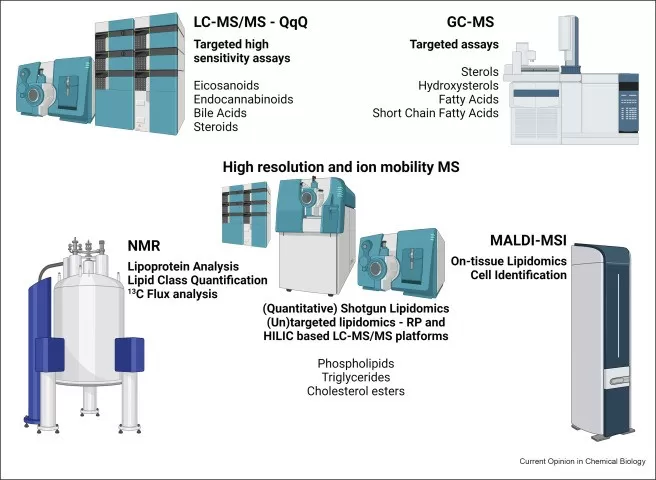
State-of-the-art lipidomics technologies and assays.
Image reproduced from Kostidis et al., 2023, Current opinion in chemical biology, licensed under the Creative Commons Attribution 4.0 International License (CC BY 4.0).
GC-MS: The Specialized Tool for Volatile and Derivative-Friendly Lipids
GC-MS has long been a foundational technique in analytical chemistry, particularly for analyzing compounds that are naturally volatile or can be made volatile through chemical derivatization. In the context of lipidomics, GC-MS plays a specialized yet indispensable role, particularly for specific lipid classes that require high precision and reproducibility in analysis.
The Principle and Process of GC-MS Lipidomics
In GC-MS, lipid samples are first vaporized and carried through a chromatographic column by an inert gas. As the sample moves through the column, components are separated based on their volatility and their interaction with the column's coating. This separation ensures that individual lipid species are isolated from complex biological matrices.
After separation, the compounds are ionized—typically using electron impact (EI) ionization—which produces fragmentation patterns characteristic of each lipid. These reproducible "fingerprints" are crucial for identifying and quantifying lipid species, and are compared to extensive reference libraries such as the NIST database to ensure accurate identification. This hard ionization approach offers rich fragmentation data, making GC-MS particularly effective for analyzing fatty acids and other small, thermally stable lipids.
Ideal Applications of GC-MS Lipidomics
GC-MS excels in several key applications in lipidomics, particularly for lipids that are volatile or can be derivatized to increase their volatility. Key applications include:
- Short-Chain Fatty Acids (SCFAs): GC-MS is ideal for analyzing volatile compounds like acetate, propionate, and butyrate (C2-C5), which are critical for gut health, inflammation regulation, and cellular signaling. These compounds are often produced in trace amounts but play crucial roles in metabolic processes.
- Fatty Acid Profiling: Following derivatization (commonly methylation), GC-MS offers excellent separation and quantification of fatty acids, allowing for detailed analysis based on chain length, saturation, and branching. This makes GC-MS highly effective for fatty acid methyl ester (FAME) analysis in metabolic studies.
- Sterols and Sterol Derivatives: GC-MS is well-suited for analyzing cholesterol, cholesteryl esters, and other sterol derivatives, providing crucial insights into lipid metabolism, including the synthesis and breakdown of these molecules.
Key Considerations of GC-MS Lipidomics
While GC-MS offers high-resolution and precise analysis, its application is limited by the volatility of the lipids being analyzed. The technique is best suited for smaller, thermally stable lipids—typically those with a molecular weight of less than 650 Da. For larger or more polar lipids, chemical derivatization is required to increase their volatility and thermal stability, enabling them to be analyzed by GC-MS.
While this derivatization step adds extra time to sample preparation, it enhances the sensitivity and separation of lipids, making GC-MS an excellent choice for targeted lipid analysis, particularly for fatty acids and sterol derivatives. The need for derivatization also makes GC-MS particularly valuable for fatty acid methyl ester (FAME) analysis and the profiling of volatile metabolites.
LC-MS vs GC-MS in Lipidomics: Key Technical Differences
To make an informed choice between LC-MS and GC-MS when considering lipidomics amalysis, it is essential to understand the key technical differences between these two platforms. These differences go beyond just the analytical principles and sample preparation methods, influencing the types of lipids that can be effectively analyzed.
Comparison of GC-MS and LC-MS for Lipidomics Applications
|
Aspect |
GC-MS |
LC-MS |
|
Separation Principle |
Volatility/Boiling Point |
Polarity/Hydrophobicity |
|
Ionization Methods |
EI (hard ionization), CI |
ESI, APCI (soft ionization) |
|
Sample Requirements |
Must be volatile/thermally stable; derivatization often needed |
No volatility requirement; analyzes native lipids |
|
Molecular Weight Range |
Typically <650 Da |
Broad range |
|
Information Obtained |
Fragmentation "fingerprints" for library matching; excellent for isomers |
Intact molecular ions; MS/MS for structural info |
|
Lipid Classes Best Suited |
SCFAs, fatty acids (after derivatization), sterols |
Phospholipids, sphingolipids, glycerolipids, complex lipids |
|
Quantitation Approach |
Typically uses internal standards and calibration curves |
Can use both relative and absolute quantification |
|
Typical Databases |
NIST, Fiehn, GMD |
|
|
Throughput Potential |
High for targeted analyses |
High for both targeted and untargeted approaches |
These platforms often provide complementary data. For example, GC-MS offers superior chromatographic resolution for certain isomers that may co-elute in LC-MS. Conversely, LC-MS provides more structural information through MS/MS fragmentation of intact molecules. In practice, many research groups employ both platforms—using GC-MS for focused SCFA or fatty acid analysis and LC-MS for comprehensive lipid profiling.
How to choose Between LC-MS and GC-MS for Lipidomics
The choice between LC-MS and GC-MS primarily depends on your specific research questions and the type of samples you are analyzing. Understanding the strengths of each technique is key to selecting the right platform for your lipidomic analysis.
When GC-MS is Preferable for Targeted Lipidomics Analysis
GC-MS is ideal when your research focuses on short-chain fatty acids (SCFAs) like acetate, propionate, and butyrate, commonly studied in gut microbiome, nutrition, or inflammation research. It excels in absolute quantification of specific fatty acids, with high precision and sensitivity (detection limits can reach as low as 0.05–0.5 μM for SCFAs). GC-MS is also advantageous when analyzing volatile lipid components that might be lost during LC-MS sample preparation or when you need to differentiate between structural isomers that are well-separated by GC but may co-elute in LC.
When LC-MS is Preferable for Untargeted Lipidomics Profiling
On the other hand, LC-MS is the better option when you need comprehensive, untargeted lipid profiling to discover novel lipid biomarkers or study pathway alterations. It is particularly effective for analyzing complex lipids like phospholipids, sphingolipids, and glycerolipids, which are difficult for GC-MS to handle. If you're working with limited sample amounts and need maximum information from minimal material, LC-MS can provide the sensitivity and detail required. It is also ideal when you need structural characterization of lipids beyond simple identification or when analyzing thermally labile lipids that would degrade in GC injection ports. Furthermore, if you need high-throughput analysis of many samples with minimal preparation, LC-MS is the go-to platform.
Hybrid Approaches for Comprehensive Lipidomics Research
For a more comprehensive lipidomic analysis, consider combining both platforms. Platform complementarity—using GC-MS for SCFA quantification alongside LC-MS for broader lipid profiling—can provide the best of both worlds. Additionally, methodological integration, such as implementing LC-based separation with GC-amenable detection for specific applications, can maximize the strengths of both methods. Multi-platform studies are especially valuable in clinical or systems biology research, where both volatile metabolites and complex lipids are crucial for gaining a full understanding of lipid-related biological processes.
Future Directions in Lipidomics: Trends and Innovations
Lipidomics is advancing rapidly with significant technological developments in high-resolution mass spectrometry, automated sample preparation, and data analysis tools. These innovations are driving lipid analysis to new levels of precision and efficiency. LC-MS/MS systems, in particular, have revolutionized lipid profiling by enabling the analysis of a wide range of lipid species with high sensitivity and accuracy. Furthermore, the integration of advanced bioinformatics has improved the interpretation of complex lipid data, allowing researchers to uncover more detailed insights into lipid-related biological processes.
As a prime example of these advancements, MetwareBio provides quantitative lipidomics services that allow for the identification and semi-quantification of over 1200 lipid species in serum and plasma samples. Their targeted assays for oxylipins, free fatty acids (FFAs), and short-chain fatty acids (SCFAs) demonstrate the power of these new technologies to perform precise and high-sensitivity lipid analyses. These services enable researchers to focus on specific lipid subclasses with unparalleled accuracy, providing critical data for a variety of metabolic and inflammatory studies.
The continued evolution of these technologies will have a profound impact on clinical research, particularly in fields like neurodegenerative diseases, cancer, and cardiovascular disorders. By facilitating the discovery of novel lipid biomarkers and enhancing our understanding of lipid metabolism in disease, lipidomics is poised to play a key role in personalized medicine. As these tools become more accessible and refined, they will likely lead to more effective diagnostic methods and targeted therapies, ultimately improving patient outcomes and advancing precision medicine.
Reference
1. Tabassum, R., Ripatti, S. Integrating lipidomics and genomics: emerging tools to understand cardiovascular diseases. Cell. Mol. Life Sci. 78, 2565–2584 (2021). https://doi.org/10.1007/s00018-020-03715-4
2. Kostidis S, Sánchez-López E, Giera M. Lipidomics analysis in drug discovery and development. Curr Opin Chem Biol. 2023;72:102256. https://doi.org/10.1016/j.cbpa.2022.102256
Read more
- Top 6 Ion Sources in Mass Spectrometry: EI, CI, ESI, APCI, APPI, and MALDI
- Common Lipidomics Databases and Software
-
Metabolomics Batch Effects
-
Understanding WGCNA Analysis in Publications
-
Deciphering PCA: Unveiling Multivariate Insights in Omics Data Analysis
- Metabolomic Analyses: Comparison of PCA, PLS-DA and OPLS-DA
-
Next-Generation Omics Solutions:
Proteomics & Metabolomics
Ready to get started? Submit your inquiry or contact us at support-global@metwarebio.com.
