Protein Complex Analysis Service
Protein Complex Analysis Overview
MetwareBio’s protein complex analysis service utilizes COMFIDENT (the COMplex FIngerprint DEconvolutioN Technology), a computational–experimental framework to quantify protein complexes on a large scale and reveal their dynamic behavior across biological conditions. COMFIDENT integrates two complementary data sources: a Complex Fingerprint Matrix (CFM) derived from high-throughput proteomic measurements of known complexes, and a Complex Connectivity Matrix (CCM) predicted from AI-based modeling of protein–protein interactions. By applying a likelihood-based statistical deconvolution algorithm, the method disentangles overlapping protein signals and infers the relative abundance of functional complexes across samples. This workflow enables precise quantification of both known and predicted protein assemblies, offering deeper insight into the cooperative nature of biological systems.
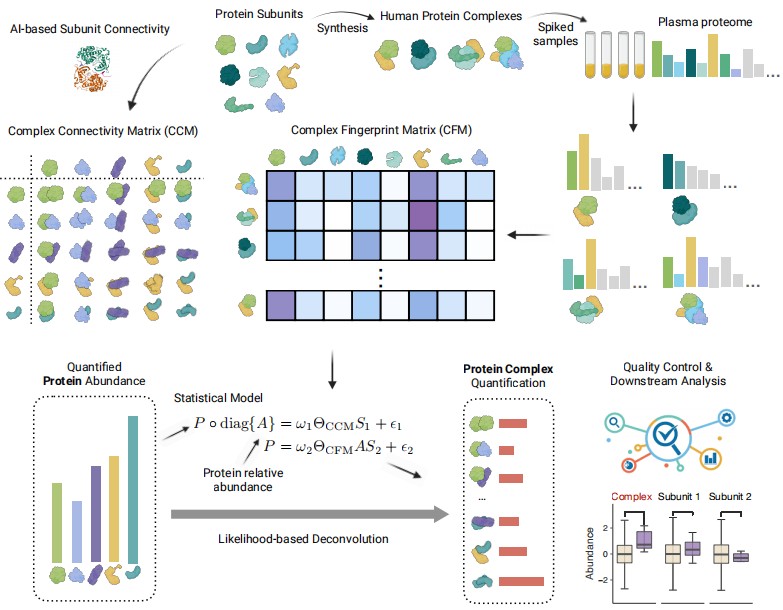
Workflow of COMFIDENT Protein Complex Quantification
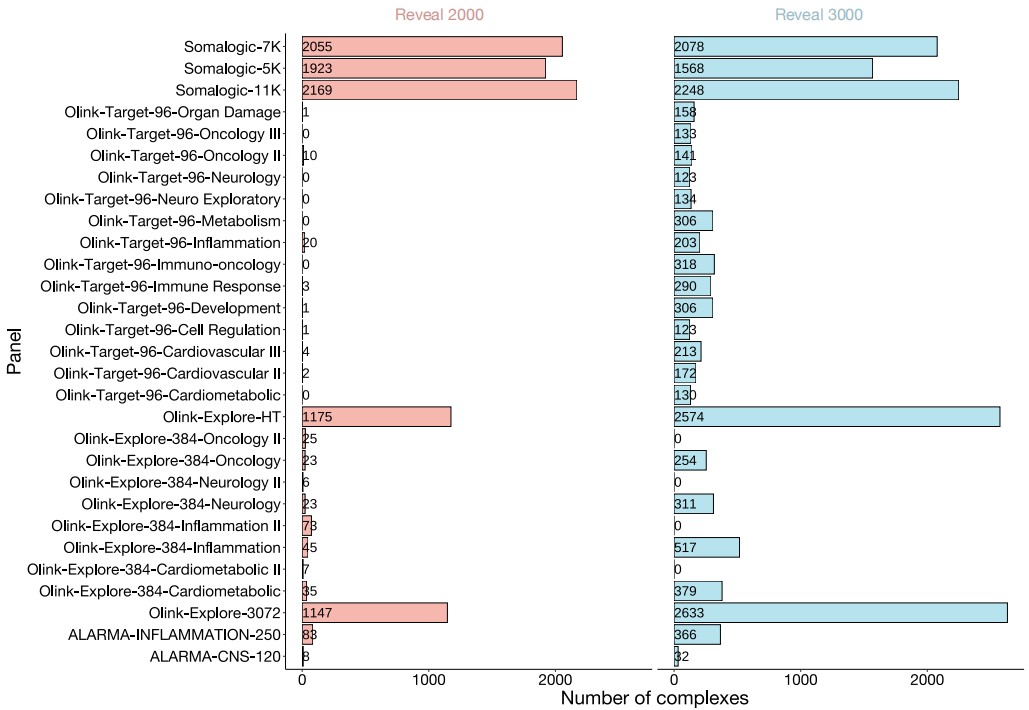
Reveal Panels for Protein Complex Profiling
Why Choose Our Protein Complex Analysis
Data Requirements & Deliverables
| SampleID | UniProt | Level |
| Sample_01 | P10145 | 6.650 |
| Sample_01 | P15692 | 8.079 |
| Sample_01 | P80098 | 3.329 |
| ... | ... | ... |
| Complex | Subunits.UniProt | Sample1 |
| FABP2-FABP6 complex | P12104;P51161 | 1.188 |
| SORT1-THPO complex | Q99523;P40225 | 0.701 |
| DECR1-THPO complex | Q16698;P40225 | 0.972 |
| ... | ... | ... |
Applications of Protein Complex Analysis
Protein complex profiling helps reveal how molecular assemblies reorganize in disease states. By quantifying complex-level changes, researchers can identify disrupted signaling pathways and interaction networks that drive disease progression, offering new insight into underlying molecular mechanisms.
Complex-level biomarkers provide higher specificity than single-protein markers, reflecting coordinated molecular activity rather than isolated abundance changes. Such markers can improve early diagnosis, patient stratification, and treatment monitoring in diverse conditions, including metabolic, cardiovascular, and inflammatory diseases.
Many drug targets function within multi-protein complexes. Protein complex analysis enables identification of target-associated assemblies and reveals how compounds modulate these interactions, supporting rational drug design and mechanism-of-action studies.
In oncology research, changes in protein complex composition often underlie key processes such as signal transduction, immune evasion, and metastasis. Complex-level quantification allows researchers to pinpoint cooperative protein networks that contribute to tumor heterogeneity and therapeutic resistance.
Case Study: Protein Complex biomarkers for diseases (submitted & unpublished)
The results in the figure below demonstrate that the PLAUR-PLAU complex shows a significant difference in abundance between the control group and both the diabetes group and the calves pain group (N = 1,046). In contrast, individual components PLAUR and PLAU do not exhibit significant differences in abundance between the control group and the case groups. These findings suggest that the interaction between PLAUR and PLAU as a complex is more strongly associated with the tested conditions than the individual proteins alone. Meaning that the proteomic resources were not properly used to identify biomarkers.
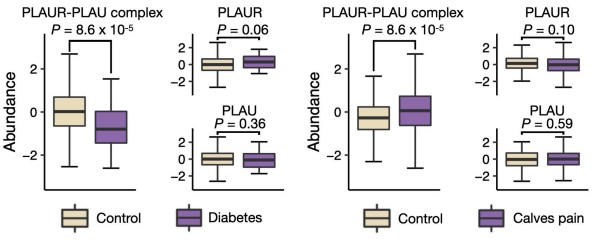
PLAUR–PLAU Complex Outperforms Single Proteins in Disease Association
FAQ on Protein Complex Analysis
We accept standardized quantitative proteomic data from platforms such as Olink or SomaScan. Each dataset should include sample identifiers, UniProt accession IDs, and normalized protein abundance values in .csv or .xlsx format.
You will receive a comprehensive table of quantified protein complexes, including complex names, subunit UniProt IDs, and abundance or confidence scores for each sample. Optional summary plots and complex–protein association analyses can also be provided.
The analysis covers more than 3,000 known and AI-predicted protein assemblies, encompassing both experimentally validated complexes and computationally inferred interactions.
There is no minimum sample requirement for compound-level analysis — a single sample is sufficient. For comparative designs (e.g., case vs. control), please determine the appropriate sample size based on your study design.
Results are delivered within 5 business days after your data submission is confirmed.