Olink Proteomics Explained: Principles, Advantages, and Comparison with MS-Based Methods
Olink proteomics is a targeted affinity-based protein analysis platform built on Proximity Extension Assay (PEA) technology. It is designed to sensitively measure predefined protein panels from low-input samples, especially plasma and other biofluids, making it highly suitable for biomarker screening and large-cohort translational studies.
In practice, researchers choose Olink when they need high-sensitivity profiling of known targets, streamlined analysis, and scalable throughput across many samples. This guide explains how PEA works, what makes Olink different from other proteomics approaches, and when Olink is a better fit than MS-based workflows.
Introduction to Olink Proteomics
 Olink proteomics is built on Proximity Extension Assay (PEA), a dual-recognition method that combines antibody specificity with DNA-based signal amplification. Two matched antibodies bind the same target protein, each carrying a unique oligonucleotide. When both antibodies bind in close proximity, their oligonucleotides hybridize and are extended to form a DNA barcode specific to that protein. This barcode is then amplified and read out by qPCR or NGS, enabling highly multiplexed protein detection from low sample volumes.
Principles of PEA Technology
The core of PEA is a dual-recognition immunoassay in which two matched antibodies bind simultaneously to a target and are uniquely labeled with DNA oligonucleotides. When the target protein is present, the antibodies are brought into proximity, allowing their DNA oligonucleotides to hybridize, serving as templates for a DNA polymerase-dependent extension step. This creates a double-stranded DNA “barcode” that is unique to the specific antigen and quantitatively proportional to the initial concentration of the target protein. Following hybridization and extension, PCR amplification is performed immediately, and the amplicons are finally quantified using microfluidic qPCR.
Olink's patented PEA technology employs a pair of specifically matched antibodies for each antigen (protein), ensuring the specificity of immunoreactions. Furthermore, PEA technology enhances specificity by attaching unique oligonucleotide pairs to each antibody pair, which, through DNA pairing specificity, prevents cross-reactivity at the immunological level during multiplex detection. Ultimately, only antibody pairs that specifically bind to their corresponding antigens form a double-stranded DNA molecule, which is then extended into a PCR-amplifiable nucleic acid double strand and detected by downstream qPCR or NGS.
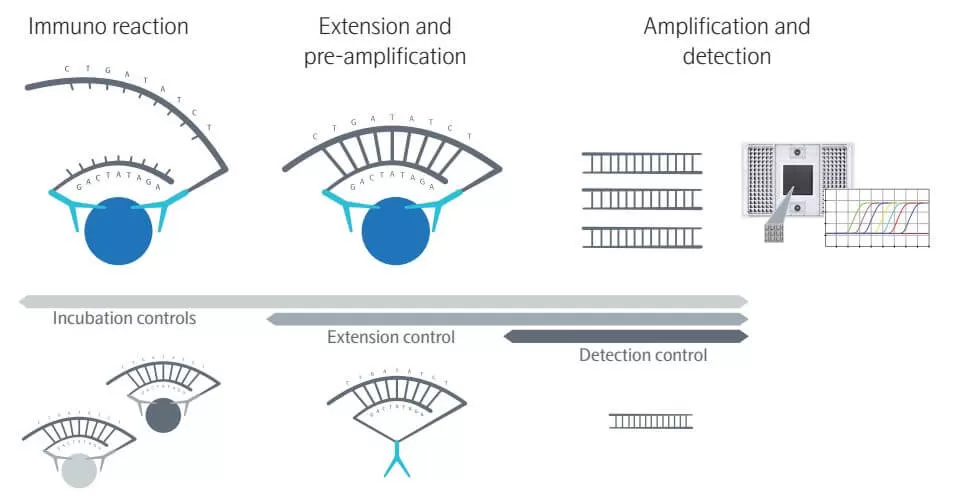
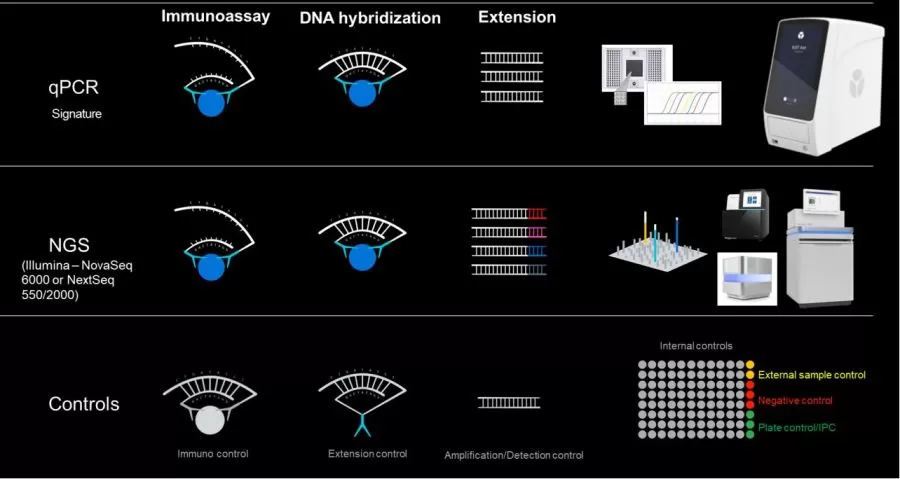
Utilizing a high-throughput microfluidic qPCR platform, PEA technology can simultaneously detect 96 proteins (92 target proteins and 4 internal controls) in a single sample well using just 1 µL of fluid. Using an NGS platform, PEA technology can detect up to 5400+ proteins in a single sample well using 8 µL of fluid, enabling highly multiplexed, high-sensitivity protein detection.
Advantages of Olink Proteomics
1. High Specificity
Leveraging patented PEA technology, robust quality control design, and thorough validation, all data exhibit exceptional specificity. Each target protein is a well-defined biomarker, overcoming the specificity challenges of traditional methods.
2. High Throughput
Capable of rapidly detecting 45 to 5400+ protein biomarkers across multiple samples.
3. Low Sample Volume
Requires less than 8 µL of sample per assay.
4. High Sensitivity
Detection sensitivity reaches fg/mL levels, allowing the identification of hundreds to thousands of low-abundance, disease-related proteins at the omics level.
5. Wide Dynamic Range
Spanning 10 logs, the dynamic range covers high, medium, and low-abundance proteins, with a particular strength in detecting low-abundance proteins.
6. Automation
Automated sample processing offers exceptional ease, accuracy, and reproducibility.
7. High Reproducibility
Utilizing mature qPCR and NGS technologies, this approach provides excellent reproducibility and high data quality, meeting the demands of big data analysis and clinical translational applications.
8. Compatibility with Diverse Samples
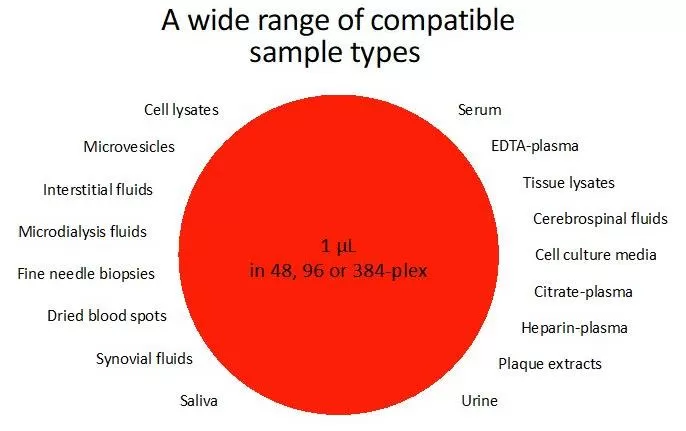
Suitable for a broad range of sample types, including serum, various plasmas, tissue lysates, cell culture media, cerebrospinal fluid, plaque lysates, urine, cell lysates, microvesicles/exosomes, interstitial fluid, microdialysis fluid, fine-needle biopsy samples, dried blood spots, synovial fluid, saliva, aqueous humor, and more. Its outstanding sensitivity is particularly advantageous for fluid samples.
Olink Proteomics vs. MS-Based Proteomics
Olink proteomics and MS-based proteomics are designed for different research purposes rather than serving as direct substitutes. Olink is a targeted affinity-based platform optimized for sensitive measurement of predefined protein panels, especially in plasma and other low-input biofluids. MS-based proteomics is better suited to unbiased protein discovery, PTM analysis, proteoform characterization, and deeper mechanistic investigation.
In the realm of proteomics, both Olink proteomics and mass spectrometry (MS)-based proteomics are powerful techniques, each offering distinct advantages and addressing different research needs. Here, we compare these two approaches to help researchers make informed decisions based on their specific objectives.
| Aspect | Olink Proteomics | MS-Based Proteomics |
|---|---|---|
| Principle | PEA-based affinity detection of predefined protein targets | Mass-to-charge measurement of peptides or proteins |
| Discovery Scope | Targeted; limited to proteins included in selected panels | Unbiased or semi-targeted discovery across broader proteomes |
| PTM / Isoform Insight | Not designed for direct PTM or proteoform characterization | Stronger for PTM analysis, proteoforms, and orthogonal validation |
| Sample Type and Input | Especially suitable for plasma and other low-input biofluids | Flexible across tissues, cells, and biofluids, often with higher workflow complexity |
| Best-Fit Use Case | High-sensitivity screening of known biomarkers in large cohorts | Discovery proteomics, mechanistic studies, PTM-focused projects, and deeper follow-up characterization |
In practice, Olink is often the better choice when the goal is sensitive, scalable profiling of known protein targets across many samples, especially in biomarker screening, translational studies, and large-cohort biofluid projects. Its predefined panels and streamlined workflow make it particularly effective for studies that prioritize sensitivity, throughput, and analytical consistency.
MS-based proteomics is usually the better choice when the research goal is unbiased protein discovery, PTM analysis, proteoform-level insight, or deeper biological interpretation. Rather than replacing MS, Olink is often most valuable as a complementary screening platform that can be followed by orthogonal validation or downstream characterization using MS-based workflows.
FAQ about Olink proteomics
Q1. What is Olink proteomics?
Olink proteomics is a targeted protein analysis platform based on Proximity Extension Assay (PEA). It is designed to sensitively measure predefined protein panels from low-volume samples, especially plasma and other biofluids.
Q2. How does PEA technology work?
PEA uses two matched antibodies linked to DNA oligonucleotides. When both antibodies bind the same target protein, the oligonucleotides come into proximity, hybridize, and are extended into a DNA barcode that can be amplified and detected by qPCR or NGS.
Q3. Is Olink an untargeted proteomics method?
No. Olink is a targeted platform. It measures proteins included in predefined panels and does not support unbiased discovery of completely novel proteins outside those panels.
Q4. Can Olink detect PTMs or protein isoforms?
Not directly. Olink is optimized for targeted protein abundance measurements, while PTM analysis and detailed isoform characterization are better handled by mass spectrometry-based proteomics.
Q5. When is Olink a better choice than MS-based proteomics?
Olink is often the better choice for low-input biofluid studies, large cohorts, and sensitive screening of known protein targets. MS-based proteomics is usually preferred for unbiased discovery, PTM analysis, and deeper mechanistic characterization.
Q6. Can Olink and mass spectrometry be used together?
Yes. A common strategy is to use Olink for sensitive, high-throughput screening and then use mass spectrometry for orthogonal validation, deeper characterization, or targeted follow-up analysis.
From Olink Screening to Stronger Proteomics Validation
Olink is a powerful option for sensitive screening of predefined protein targets, especially in low-input and large-cohort studies. In many research workflows, however, Olink findings still need downstream interpretation, orthogonal validation, or follow-up characterization. At MetwareBio, we support researchers with MS-based proteomics solutions, including quantitative proteomics, PTM analysis, and project-oriented study design for deeper biological insight. If you are planning a proteomics project, our team can help you build the right downstream workflow for your samples and research goals.
Talk to Our Proteomics Team >>
Read more About Proteomics
If you would like to explore related proteomics technologies and workflow decisions, the following articles may also be helpful:
-
Proteomics Platform Comparison: MS, DIA, Olink, and SomaScan
A broader comparison of major proteomics platforms, useful when you want to understand where Olink fits within the wider landscape of targeted and MS-based workflows. -
Top-Down vs. Bottom-Up Proteomics: Unraveling the Secrets of Protein Analysis
A practical guide to two major MS-based proteomics strategies, especially helpful for readers comparing targeted screening with deeper protein characterization approaches. -
Comprehensive Guide to Basic Bioinformatics Analysis in Proteomics
An introduction to common proteomics data analysis steps, ideal for readers who want to better understand how protein profiling results are interpreted after acquisition. -
Proteomics Sample Preparation: Choosing the Right Extraction Methods
A useful reference for planning sample preparation workflows, especially when protein recovery and downstream analytical compatibility are critical. -
Protein Sample Preparation Tips: Serum or Plasma?
A practical article for biofluid studies, particularly relevant for researchers working with plasma or serum samples in Olink-related biomarker projects.