In mass spectrometry-based metabolomics, the quality of the metabolite profile begins with extraction. Biological samples contain metabolites that differ widely in polarity, abundance, stability, protein binding, and ionization behavior, making extraction method selection essential for reliable metabolite coverage, recovery, reproducibility, and quantitative accuracy. A protocol suitable for amino acids or organic acids may fail to recover lipids, steroids, or volatile metabolites effectively. Choosing the right metabolite extraction method requires alignment between the analytical goal, sample matrix, metabolite chemistry, and downstream LC-MS or GC-MS workflow. This article compares commonly used metabolite extraction methods and provides a practical guide for optimizing extraction strategies across different metabolomics applications.
1. WHY DIFFERENT METABOLITE EXTRACTION METHODS ARE NEEDED
The metabolome is chemically diverse, matrix-dependent, and highly sensitive to sample preparation. A single extraction strategy cannot recover all metabolites with the same efficiency because metabolites differ in solubility, stability, abundance, and analytical behavior. In mass spectrometry-based metabolomics, extraction conditions directly influence which compounds are detected, how consistently they are measured, and how accurately biological differences can be interpreted.
1.1 Metabolite Properties Shape Extraction Efficiency
Metabolites span a wide chemical range, from highly polar organic acids, amino acids, nucleotides, and sugar phosphates to hydrophobic lipids, steroids, and other nonpolar compounds. These molecules differ in polarity, hydrophobicity, pKa, volatility, protein binding, and chemical stability. A solvent system that efficiently recovers polar metabolites may not effectively extract lipid-like compounds, while conditions that improve hydrophobic metabolite recovery may reduce the recovery or stability of highly polar or labile metabolites. Some compounds are also sensitive to oxidation, hydrolysis, pH, temperature, or repeated drying and reconstitution. As a result, metabolite chemistry is one of the main reasons why extraction method selection has a direct impact on metabolite coverage and data quality.
1.2 Sample Matrix Determines Interference and Processing Requirements
The same metabolite extraction workflow can perform differently across sample types because each matrix introduces its own interferences. Plasma and serum contain abundant proteins, salts, and phospholipids that can contribute to ion suppression or ion enhancement. Whole blood adds cellular metabolism, hemolysis risk, and anticoagulant-related variability. Tissue and cell samples require rapid quenching, low-temperature handling, and efficient disruption to preserve intracellular metabolites. Urine and culture medium are usually lower in protein but may contain salts or external medium components that affect chromatography and ionization. Fecal, microbial, and plant samples can be especially challenging because fibers, pigments, polysaccharides, lipids, cell wall structures, and secondary metabolites may interfere with LC-MS or GC-MS analysis. These matrix-specific factors determine how much cleanup, homogenization, stabilization, and dilution are needed before analysis.
1.3 Analytical Goals Define Method Priorities
Different metabolomics applications evaluate extraction performance by different criteria. Untargeted metabolomics emphasizes broad metabolite coverage, reproducible feature detection, and high-throughput processing. Targeted metabolomics places greater emphasis on recovery, matrix effect, sensitivity, linearity, precision, and accuracy. Lipidomics requires strong performance for hydrophobic and amphipathic molecules, while volatile metabolomics depends on workflows that preserve and capture volatile or semi-volatile compounds. Therefore, extraction strategy should be aligned with the scientific goal of the study, whether the priority is discovery, accurate quantification, class-specific profiling, or volatile metabolite analysis.
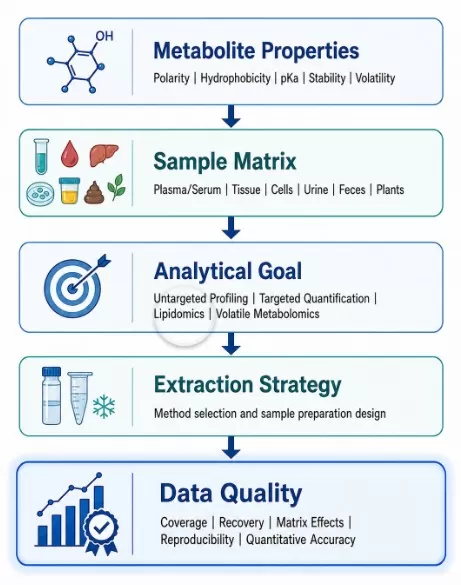
Figure 1. Key Factors Driving Metabolite Extraction Strategy in Mass Spectrometry-Based Metabolomics
2. COMMON METABOLITE EXTRACTION METHODS IN MASS SPECTROMETRY-BASED METABOLOMICS
Most metabolomics sample preparation workflows are built from a limited number of extraction principles. Each method has a characteristic balance between coverage, selectivity, matrix cleanup, throughput, cost, and automation potential.
2.1 Protein Precipitation
Protein precipitation is a widely used strategy for LC-MS metabolomics. Cold methanol, acetonitrile, or methanol-acetonitrile-water is added to biological samples to precipitate proteins while small metabolites remain in the supernatant. This approach is simple, fast, inexpensive, and compatible with high-throughput workflows.
Methanol-acetonitrile-water extraction is often used as a broad-coverage starting point because it spans a useful polarity range: methanol supports polar and semi-polar metabolites, acetonitrile improves protein precipitation and complements recovery of some less polar compounds, and water helps maintain hydrophilic metabolite solubility. Its main limitations are low cleanup selectivity, co-extraction of salts and phospholipids, potential matrix effects, and limited enrichment for low-abundance targets. In human plasma, solvent precipitation showed broad metabolite coverage and strong precision but remained susceptible to matrix effects (Sitnikov et al., 2016; Lepoittevin et al., 2023).
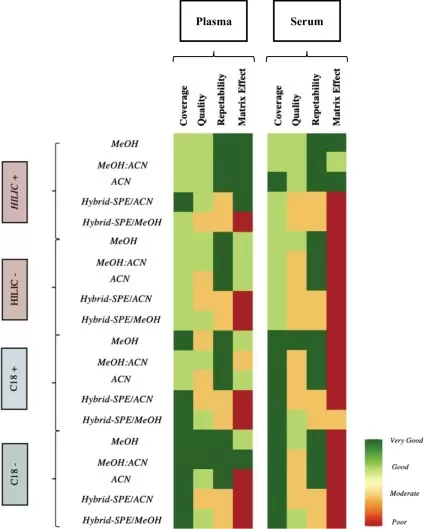
Figure 2. Summary of extract method performance for plasma vs. serum. Image reproduced from Lepoittevin et al., 2023, Cellular & Molecular Biology Letters, 28(1), 43.
2.2 Liquid-Liquid Extraction
Liquid-liquid extraction (LLE) separates metabolites based on their distribution between two immiscible phases. Common systems include chloroform-methanol-water, MTBE-methanol-water, ethyl acetate, hexane, and pH-adjusted LLE for acidic or basic metabolites. LLE is particularly useful for hydrophobic metabolites, lipids, steroids, fatty acids, bile acids, and compounds that partition efficiently into organic solvents.
In lipidomics, several standardized extraction workflows have been developed from these solvent-partitioning principles and are now widely used as reference methods. Folch, Bligh-Dyer, and Matyash-type workflows remain important examples. Comparative plasma studies suggest that Folch and Matyash methods are robust for lipidomic analysis, while primary metabolites may be better captured by protein precipitation with organic solvent mixtures (Lee et al., 2014). Biphasic extraction, a specific LLE format, separates an aqueous phase for polar metabolites and an organic phase for lipids, making it useful when both metabolomics and lipidomics are required from limited sample material. However, solvent ratios, phase separation, interphase contamination, and emulsion formation must be carefully controlled (Ulmer et al., 2018).
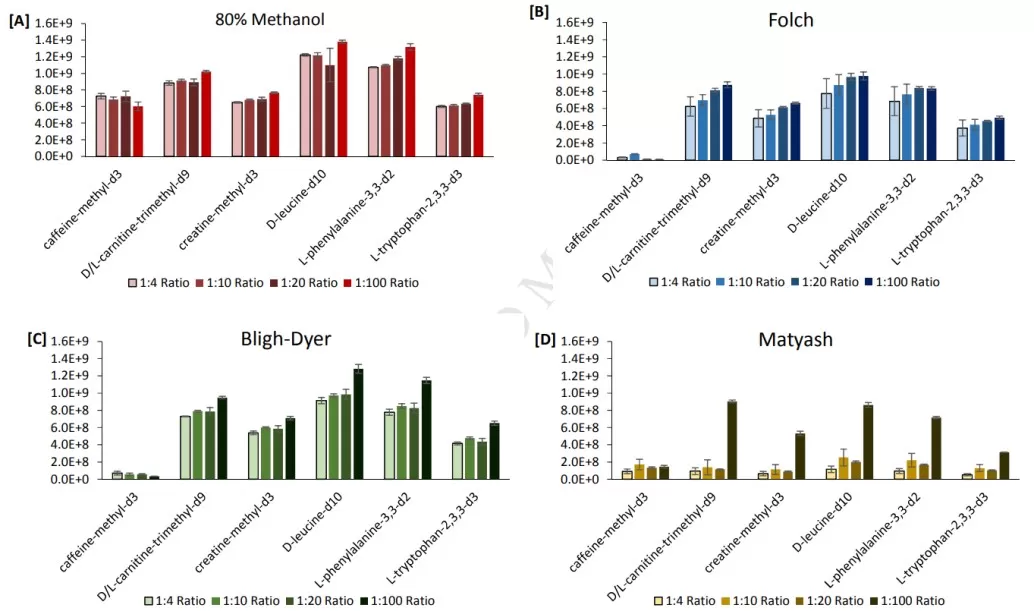
Figure 3. Comparison of plasma ISTD peak areas for the 80% MeOH [A], Folch [B], Bligh-Dyer [C], and Matyash [D] extraction methods for each human plasma sample-to-solvent ratio (1:4, 1:10, 1:20, and 1:100). Image reproduced from Ulmer et al., 2018, Analytica Chimica Acta, 1037, 351–357.
2.3 Solid-Phase Extraction
Solid-phase extraction (SPE) uses sorbent chemistry to retain target metabolites or remove matrix interferences. Common formats include C18, HLB, HILIC-type sorbents, ion-exchange, mixed-mode SPE, phospholipid removal plates, and online SPE-LC-MS. SPE is valuable when cleanup, selectivity, or enrichment is more important than broad untargeted coverage. It is often used for low-abundance metabolites, hormones, bile acids, neurotransmitters, oxylipins, and plasma or serum samples with strong matrix effects. Compared with LLE, SPE is more compatible with 96-well automation and large cohorts. Its limitations include higher consumable cost, method development complexity, potential analyte loss, and the need to match sorbent chemistry to the target class.
2.4 Derivatization-Assisted Analysis
Derivatization is an auxiliary sample preparation strategy that modifies functional groups to improve ionization efficiency, volatility, thermal stability, chromatographic retention, or detection sensitivity. It is commonly used for short-chain fatty acids, amino acids, organic acids, carbonyl compounds, neurotransmitters, and GC-MS metabolomics workflows. For GC-MS, oximation and silylation help make polar metabolites more volatile and thermally stable. For LC-MS, derivatization can improve signal response or retention for highly polar or poorly ionized compounds. The main limitation is added variability from reaction completeness, reagent purity, moisture, temperature, incubation time, and byproducts.
2.5 Dilute-and-Shoot and Minimal Sample Preparation
Dilute-and-shoot uses dilution, centrifugation, and sometimes filtration before direct injection. It is most suitable for urine, culture medium, and other low-protein liquid matrices. Its strengths are speed, low cost, minimal sample loss, and reduced preparation-induced variation. However, salts, medium components, and endogenous matrix compounds may cause ion suppression, poor peak shape, column contamination, or carryover.
2.6 SPME and Headspace Extraction
Solid-phase microextraction (SPME) and headspace extraction are designed for volatile and semi-volatile metabolites. A coated fiber or sorbent phase captures analytes from the sample or headspace, followed by desorption into GC-MS. These methods are useful for volatile organic compounds, breathomics, food aroma analysis, microbial fermentation studies, and fecal volatile profiling. Their strengths include low-solvent operation and volatile analyte enrichment, while limitations include narrow metabolite scope, coating-dependent selectivity, and sensitivity to extraction conditions.
3. HOW TO CHOOSE A METABOLITE EXTRACTION METHOD BY TARGET AND SAMPLE MATRIX
Selecting a metabolite extraction method requires balancing metabolite coverage, chemical selectivity, matrix cleanup, throughput, and compatibility with the analytical goal. No single workflow performs best across all sample types or metabolite classes. A practical choice should start from the study objective, target chemistry, and sample matrix.
| Method | Best Suited For | Main Strengths | Main Limitations |
|---|---|---|---|
| Protein precipitation | Untargeted LC-MS, high-throughput plasma/serum, tissue or cell extracts | Simple, fast, broad metabolite coverage | Limited cleanup, matrix effects, weak enrichment |
| LLE / biphasic extraction | Lipids, hydrophobic metabolites, steroids, bile acids, combined metabolomics-lipidomics | Better selectivity for nonpolar compounds; phase separation | Lower throughput, emulsion risk, solvent toxicity |
| SPE | Targeted assays, low-abundance metabolites, complex matrices | Strong cleanup, enrichment, automation potential | Higher cost, method development required |
| Derivatization | Poorly ionized, poorly retained, volatile, or unstable compounds | Improved sensitivity, retention, volatility, stability | Added reaction variability |
| Dilute-and-shoot | Urine, culture medium, clean liquid matrices | Fast, low cost, minimal sample loss | Salt effects, contamination, limited cleanup |
| SPME / headspace | VOCs and semi-volatile metabolites | Solvent-free enrichment, GC-MS compatibility | Narrow scope, condition-sensitive |
For LC-MS untargeted metabolomics without predefined targets, cold methanol, acetonitrile, or methanol-acetonitrile-water precipitation is usually a practical starting point because it supports broad coverage, reproducibility, and high-throughput processing. For targeted metabolomics, extraction should follow compound chemistry. Hydrophobic targets, including lipids, steroids, fatty acids, and bile acids, often require MTBE- or chloroform-based liquid-liquid extraction. Low-abundance or interference-prone targets may require SPE, while volatile compounds or GC-MS workflows often require derivatization, headspace extraction, or SPME.
Sample matrix determines the need for cleanup, disruption, and stabilization. Plasma and serum contain proteins, phospholipids, and salts, so precipitation is suitable for broad profiling, while SPE or LLE may be needed for targeted or lipid-focused assays. Plasma and serum extraction comparisons have also shown strong performance for methanol- and methanol-acetonitrile-based precipitation, while emphasizing that matrix choice can influence metabolomics results (Lepoittevin et al., 2023). Tissue and cell samples require rapid quenching, low-temperature homogenization, and standardized solvent-to-sample ratios; extraction performance can vary by protocol, sample type, and metabolite class (Andresen et al., 2022). Urine and culture medium may allow simpler preparation but still require salt and matrix control. Fecal, microbial, and plant samples usually need stronger disruption and matrix-specific cleanup.
4. A PRACTICAL WORKFLOW FOR METABOLITE EXTRACTION METHOD SELECTION
A practical extraction workflow should begin with the analytical goal, then narrow the method choice by sample matrix and metabolite chemistry. For broad LC-MS metabolomics without predefined targets, cold organic solvent precipitation is usually a suitable starting point. When specific targets are known, the method should be selected according to compound class: hydrophobic or lipid-like metabolites often require organic-rich or phase-partitioning extraction, low-abundance targets may require selective cleanup or enrichment, and volatile or poorly ionized compounds may require derivatization, headspace extraction, or GC-MS-compatible preparation. Sample matrix should then be considered to adjust the workflow: protein-rich biofluids may need stronger cleanup, tissue and cell samples require rapid quenching and efficient disruption, and complex matrices such as feces, plants, or microbial samples often require more intensive homogenization. After an initial method is selected, method performance should be validated against the required coverage, recovery, reproducibility, and quantitative criteria. Further optimization or combined extraction strategies should be considered when the initial workflow does not meet these requirements.
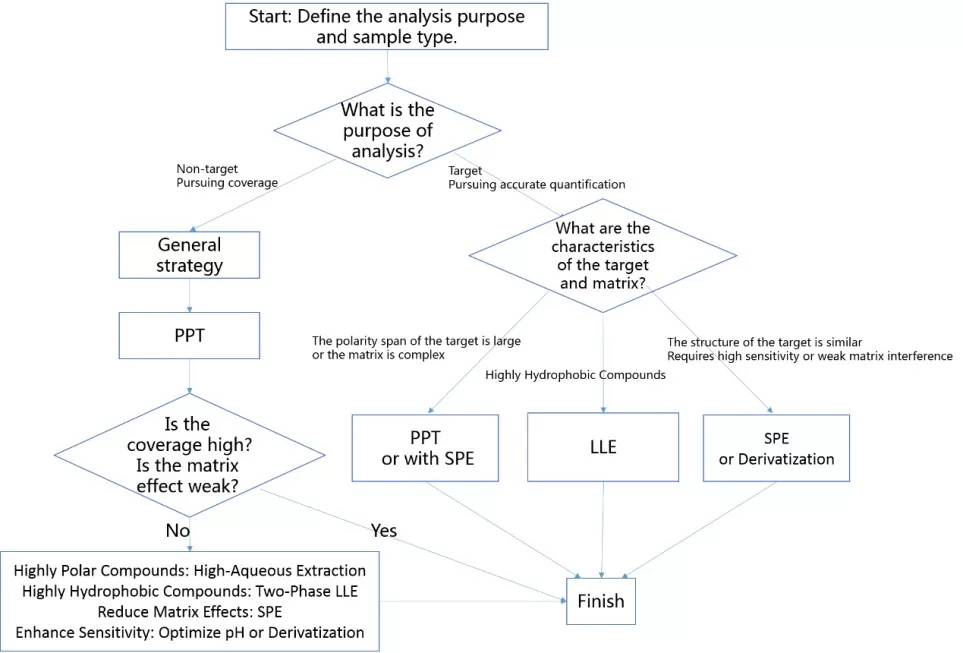
Figure 4. Selection strategy for metabolite extraction methods in metabolomics. PPT, protein precipitation; LLE, liquid-liquid extraction; SPE, solid-phase extraction.
5. HOW TO OPTIMIZE AND VALIDATE A METABOLITE EXTRACTION METHOD
Optimization should be guided by measured performance rather than assumptions about solvent behavior. Once an initial extraction method has been selected, key variables should be refined according to metabolite class, sample matrix, and analytical goal.
5.1 Optimize Solvent Composition
Solvent composition is usually the first variable to adjust. Methanol and acetonitrile can be compared in terms of protein precipitation efficiency, metabolite coverage, and repeatability. For highly polar metabolites, increasing the water percentage may improve solubility and compatibility with hydrophilic interaction chromatography (HILIC). For hydrophobic compounds or lipid-rich extracts, isopropanol, methyl tert-butyl ether (MTBE), chloroform, or other organic-rich systems may improve recovery. Solvent-to-sample ratio should also be optimized, especially for tissue extraction, lipidomics, and studies with limited sample material.
5.2 Optimize pH and Additives
pH and additives should be adjusted only when they support a clear analytical purpose. Volatile acids, bases, or buffers, such as formic acid, acetic acid, ammonium formate, ammonium acetate, and ammonium hydroxide, may improve recovery, stability, or chromatographic behavior for selected metabolites. Antioxidants or chelators can be useful for labile, oxidation-sensitive, or metal-sensitive compounds. However, pH modification may also introduce artifacts: acidification can promote hydrolysis for some metabolites, alkaline conditions may destabilize others, and nonvolatile additives can compromise MS performance.
5.3 Optimize Sample Disruption and Quenching
Sample disruption and quenching should be matched to the matrix. Tissue samples often require liquid nitrogen grinding or mechanical homogenization, while fecal, microbial, and plant samples may need stronger disruption such as bead beating. Cell metabolomics requires rapid quenching to limit metabolic turnover before extraction. These steps should be performed under low-temperature conditions whenever possible, because excessive heat, oxidation, delayed processing, or inconsistent homogenization can introduce technical variation.
5.4 Optimize Drying and Reconstitution
Drying and reconstitution can also affect metabolite recovery and reproducibility. Nitrogen evaporation or vacuum concentration may be useful for concentrating analytes, but volatile or labile metabolites can be lost during drying. After drying, the reconstitution solvent should be compatible with the initial LC conditions to avoid peak distortion. Complete reconstitution is especially important for hydrophobic metabolites, which may show poor solubility after evaporation.
5.5 Validate Extraction Performance
Validation should confirm that the optimized method is fit for purpose. For untargeted metabolomics, key indicators include metabolite coverage, pooled QC relative standard deviation, blank contribution, peak shape, retention stability, and batch reproducibility. For targeted metabolomics, recovery, matrix effect, internal standard response, limit of detection, lower limit of quantification, linearity, precision, accuracy, carryover, and processed sample stability should be assessed. Pooled QC samples, blanks, and internal standards help distinguish true biological variation from extraction-related technical variation.
6. CONCLUSION: MATCH EXTRACTION STRATEGY TO THE BIOLOGICAL QUESTION
Metabolite extraction is not a universal protocol but a strategic choice. Protein precipitation and single-phase organic solvent extraction are practical for high-throughput, broad-coverage LC-MS metabolomics. LLE is better suited for hydrophobic metabolites and lipid-focused analysis. SPE is preferred when matrix cleanup, enrichment, and quantitative reliability are central. Derivatization is valuable when a compound class is difficult to ionize, retain, stabilize, or volatilize. Dilute-and-shoot is efficient for clean liquid matrices, and SPME or headspace extraction is specialized for volatile metabolites.
The most appropriate method is not necessarily the most complex one. It is the method that best fits the biological question, sample matrix, metabolite chemistry, analytical platform, and validation requirements. For service-based projects, early discussion of sample type, target classes, expected coverage, and quantification needs can reduce method mismatch and improve the reliability of downstream metabolomics interpretation.
PARTNER WITH METWAREBIO FOR METABOLOMICS RESEARCH
MetwareBio is a global metabolomics CRO providing comprehensive mass spectrometry-based metabolomics services for biomedical, pharmaceutical, agricultural, and microbiome research.
MetwareBio's service portfolio covers LC-MS untargeted metabolomics, a wide range of targeted metabolomics assays, lipidomics, and GC-MS volatile metabolomics. To support reliable and biologically meaningful results, extraction workflows are optimized according to the research objective, sample matrix, and target metabolite classes. From metabolite extraction and mass spectrometry analysis to data processing, statistical analysis, pathway interpretation, and biological insight generation, MetwareBio provides end-to-end support for metabolomics projects.
If you are interested in metabolomics analysis, targeted metabolite quantification, lipid profiling, or volatile metabolite detection, please do not hesitate to contact us.
Contact UsRead More: Metabolomics Sample Preparation & LC-MS Workflows
Extraction is the first critical step in metabolomics — but the workflow doesn't stop there. Explore these related articles to learn how sample matrix selection, LC-MS principles, targeted profiling, and metabolite identification all connect downstream of your extraction strategy.
Once extraction is complete and metabolite data is acquired, identifying what you've detected becomes the next challenge. This article explains the MSI confidence level framework, the role of spectral matching and retention time alignment, and how to navigate the continuum from tentative annotation to confirmed identification in LC-MS metabolomics.
Protein precipitation is the most common first step in untargeted metabolomics — but the full workflow continues through data acquisition, peak picking, alignment, normalization, and statistical analysis. This guide walks through the complete untargeted metabolomics pipeline from sample preparation to biological interpretation.
Before choosing an extraction method, you need to decide on the right sample matrix. This article compares plasma, serum, urine, tissue, fecal, and saliva matrices across metabolite stability, coverage, throughput, and analytical compatibility — helping you align matrix choice with study design.
For lipidomics and hydrophobic metabolite profiling, the choice between MTBE-based and chloroform–methanol (Folch/Bligh-Dyer) extraction systems significantly affects lipid class coverage, recovery, and operator safety. This article provides a head-to-head comparison to help you select the right biphasic extraction strategy.
Fecal samples are among the most extraction-challenging matrices in metabolomics due to high fiber, pigment, and microbial content. This article covers how fecal metabolomics is performed — including homogenization, matrix cleanup, and targeted vs. untargeted profiling — and what it reveals about microbiota–host chemical communication.
Understanding the LC-MS platform downstream of your extraction protocol is essential for method development. This article covers the key operating principles of liquid chromatography–mass spectrometry, instrument types, ionization modes, and common workflow pitfalls — giving you the context to optimize extraction conditions for your analytical platform.
References
- Andresen, C., Boch, T., Gegner, H. M., Mechtel, N., Narr, A., Birgin, E., Rasbach, E., Rahbari, N., Trumpp, A., Poschet, G., & Hübschmann, D. (2022). Comparison of extraction methods for intracellular metabolomics of human tissues. Frontiers in Molecular Biosciences, 9, 932261. https://doi.org/10.3389/fmolb.2022.932261
- Ulmer, C. Z., Jones, C. M., Yost, R. A., Garrett, T. J., & Bowden, J. A. (2018). Optimization of Folch, Bligh-Dyer, and Matyash sample-to-extraction solvent ratios for human plasma-based lipidomics studies. Analytica Chimica Acta, 1037, 351–357. https://doi.org/10.1016/j.aca.2018.08.004
- Lee, D. Y., Kind, T., Yoon, Y. R., Fiehn, O., & Liu, K. H. (2014). Comparative evaluation of extraction methods for simultaneous mass-spectrometric analysis of complex lipids and primary metabolites from human blood plasma. Analytical and Bioanalytical Chemistry, 406(28), 7275–7286. https://doi.org/10.1007/s00216-014-8124-x
- Lepoittevin, M., Blancart-Remaury, Q., Kerforne, T., Pellerin, L., Hauet, T., & Thuillier, R. (2023). Comparison between 5 extractions methods in either plasma or serum to determine the optimal extraction and matrix combination for human metabolomics. Cellular & Molecular Biology Letters, 28(1), 43. https://doi.org/10.1186/s11658-023-00452-x
- Sitnikov, D. G., Monnin, C. S., & Vuckovic, D. (2016). Systematic Assessment of Seven Solvent and Solid-Phase Extraction Methods for Metabolomics Analysis of Human Plasma by LC-MS. Scientific Reports, 6, 38885. https://doi.org/10.1038/srep38885