How to Perform Gene Ontology (GO) Enrichment Analysis
Gene Ontology (GO) enrichment analysis helps researchers interpret a list of differentially expressed genes or proteins by identifying biological functions, cellular locations, or molecular activities that are statistically overrepresented. It is commonly used after RNA-seq, proteomics, and other omics experiments to move from a long candidate list to testable biological hypotheses.
This guide explains what GO enrichment analysis means, how the three GO categories--Biological Process, Molecular Function, and Cellular Component--should be interpreted, and how to perform a practical GO enrichment workflow using the clusterProfiler R package. We also discuss key parameters such as OrgDb, keyType, universe, pAdjustMethod, p.adjust, GeneRatio, BgRatio, and how GO enrichment can support downstream pathway and multi-omics interpretation.
What Is GO Enrichment Analysis?
Gene Ontology (GO) enrichment analysis is a commonly used bioinformatics method for interpreting the biological significance of gene sets. It identifies statistically overrepresented functional terms within a gene list by comparing it to reference annotations in the GO database. The analysis employs rigorous statistical methods (e.g., hypergeometric or Fisher’s exact tests) to calculate enrichment significance, enabling researchers to extract biologically meaningful insights from large-scale omics data. These insights can support hypothesis generation for molecular mechanisms, disease-associated pathways, and downstream experimental validation. The GO database categorizes gene functions into three domains:
1. Molecular Function (MF): Describes biochemical activities of gene products (e.g., enzymatic catalysis, ligand binding). Example: Enrichment in "ion channel activity" (GO:0005216) suggests involvement in ion transport regulation.
2. Cellular Component (CC): Indicates subcellular localization (e.g., cell membrane, nucleus, mitochondria). Example: Enrichment in "mitochondrial matrix" (GO:0005759) implies roles in mitochondrial metabolism.
3. Biological Process (BP): Represents broader biological events (e.g., cell cycle, apoptosis, signal transduction). Example: Enrichment in "inflammatory response" (GO:0006954) highlights genes regulating immune pathways.
Table 1. Three GO Categories in Enrichment Analysis
|
GO category |
What it describes |
Example interpretation |
|
Biological Process (BP) |
Broader biological programs or events |
Enrichment in inflammatory response suggests immune-related regulation |
|
Molecular Function (MF) |
Molecular activities of gene products |
Enrichment in kinase activity suggests changes in signaling activity |
|
Cellular Component (CC) |
Subcellular locations where gene products act |
Enrichment in mitochondrial matrix suggests mitochondrial involvement |
When Should You Use GO Enrichment Analysis?
GO enrichment analysis is most useful when you already have a defined list of genes or proteins, such as differentially expressed genes from RNA-seq or significantly altered proteins from quantitative proteomics. It helps answer whether specific biological processes, molecular functions, or cellular components are overrepresented in that list compared with an appropriate background gene set. For ranked gene lists without a strict cutoff, GSEA may be a better choice.
How to Run GO Enrichment Analysis with clusterProfiler
'clusterProfiler' is a widely used R package for functional enrichment analysis, supporting GO, KEGG, and Reactome pathways. Below is a practical workflow for GO enrichment analysis.
Step 1: Install and Load Required R Packages
Install and load required R packages:
if (!requireNamespace("BiocManager", quietly = TRUE)) {
install.packages("BiocManager")
}
if (!requireNamespace("clusterProfiler", quietly = TRUE)) {
BiocManager::install("clusterProfiler")
}
if (!requireNamespace("org.Hs.eg.db", quietly = TRUE)) {
BiocManager::install("org.Hs.eg.db")
}
if (!requireNamespace("GO.db", quietly = TRUE)) {
BiocManager::install("GO.db")
}
if (!requireNamespace("enrichplot", quietly = TRUE)) {
BiocManager::install("enrichplot")
}
library(clusterProfiler)
library(org.Hs.eg.db)
library(GO.db)
library(enrichplot)
Step 2: Prepare Gene IDs and Background Genes
Assume a differentially expressed gene (DEG) list is generated from RNA-seq analysis. Load the data:
DiffDataFrame <- read.table("B_vs_A.diff.xls", sep = "t", header = TRUE)
head(DiffDataFrame)
## ID baseMean log2FoldChange pvalue padj regulated
## 1 ENSG00000001084 3155.3666 1.66483 0 0 up
## 2 ENSG00000023909 6448.8749 1.85860 0 0 up
## 3 ENSG00000100292 10027.3640 5.78664 0 0 up
## 4 ENSG00000117525 5109.3190 1.90061 0 0 up
## 5 ENSG00000132002 8206.3453 1.29174 0 0 up
## 6 ENSG00000140961 885.8424 3.50181 0 0 up
Step 3: Run enrichGO for GO Enrichment Analysis
Use the 'enrichGO' function:
library(clusterProfiler)
library(org.Hs.eg.db)
enrichFrame <- enrichGO(gene = DiffDataFrame$ID,
OrgDb = org.Hs.eg.db,
keyType = "ENSEMBL",
ont = "ALL",
pAdjustMethod = "BH",
pvalueCutoff = 0.05,
qvalueCutoff = 0.2)
Table 2. Key enrichGO Parameters in clusterProfiler
|
Parameter |
What it controls |
Practical note |
|
gene |
Input gene IDs for enrichment testing |
Use IDs that match keyType, such as ENSEMBL, ENTREZID, or SYMBOL. |
|
OrgDb |
Organism-specific annotation database |
Use org.Hs.eg.db for human, org.Mm.eg.db for mouse, etc. |
|
keyType |
Identifier type of the input genes |
Incorrect keyType is a common reason for failed or incomplete mapping. |
|
ont |
GO ontology category |
Use BP, MF, CC, or ALL depending on the research question. |
|
universe |
Background gene set |
Recommended: use all genes detected/tested in the experiment. |
|
pAdjustMethod |
Multiple-testing correction method |
BH/FDR is commonly used in omics enrichment analysis. |
|
pvalueCutoff / qvalueCutoff |
Significance thresholds |
Report both raw and adjusted significance when explaining results. |
|
readable |
Converts gene IDs to gene symbols when possible |
Improves result readability for biological interpretation. |
Step 4: Interpret and Visualize GO Enrichment Results
Analysis results: the enrichFrame object contains a wide range of information, such as the ID, name, description of the pathway, the number of genes enriched, the proportion of the number of genes of the pathway in the background gene set, the p-value, the adjusted p-value, and so on. We can get the detailed enrichment analysis results by viewing the contents of enrichFrame.
Table 3. How to Interpret GO Enrichment Result Fields
|
Field |
Meaning |
How to use it |
|
ID / Description |
GO term identifier and term name |
Use the term name for biological interpretation; keep ID for reproducibility. |
|
GeneRatio |
Input genes annotated to the GO term divided by total input genes used in the test |
Higher ratio suggests stronger representation in the input list. |
|
BgRatio |
Background genes annotated to the GO term divided by all background genes |
Compare with GeneRatio to understand overrepresentation. |
|
pvalue |
Raw enrichment significance |
Useful but should not be interpreted alone in multiple testing. |
|
p.adjust / qvalue |
Multiple-testing adjusted significance |
Use adjusted values to prioritize robust GO terms. |
|
Count |
Number of input genes annotated to the term |
Helps avoid over-interpreting very small gene counts. |
|
RichFactor / FoldEnrichment |
Strength of enrichment relative to background |
Use with adjusted p-value and biological relevance, not alone. |
enrichResult <- as.data.frame(enrichFrame)
head(enrichResult[, 1:8])
## ONTOLOGY ID
## GO:0006986 BP GO:0006986
## GO:0035966 BP GO:0035966
## GO:0044344 BP GO:0044344
## GO:0071774 BP GO:0071774
## GO:0009408 BP GO:0009408
## GO:0034976 BP GO:0034976
## Description GeneRatio
## GO:0006986 response to unfolded protein 14/234
## GO:0035966 response to topologically incorrect protein 14/234
## GO:0044344 cellular response to fibroblast growth factor stimulus 12/234
## GO:0071774 response to fibroblast growth factor 12/234
## GO:0009408 response to heat 11/234
## GO:0034976 response to endoplasmic reticulum stress 16/234
## BgRatio RichFactor FoldEnrichment zScore
## GO:0006986 161/21468 0.08695652 7.977703 9.329148
## GO:0035966 178/21468 0.07865169 7.215788 8.741703
## GO:0044344 126/21468 0.09523810 8.737485 9.144190
## GO:0071774 134/21468 0.08955224 8.215844 8.795916
## GO:0009408 136/21468 0.08088235 7.420437 7.884896
## GO:0034976 316/21468 0.05063291 4.645245 6.852866
Visualization: clusterProfiler provides a variety of visualizations to present GO enrichment analysis results. For example, drawing bar charts and bubble charts:
# Drawing bar graphs
barplot(enrichFrame,
x = "GeneRatio",
color = "p.adjust",
title = "Top 15 of GO Enrichment",
showCategory = 15,
label_format = 80
)
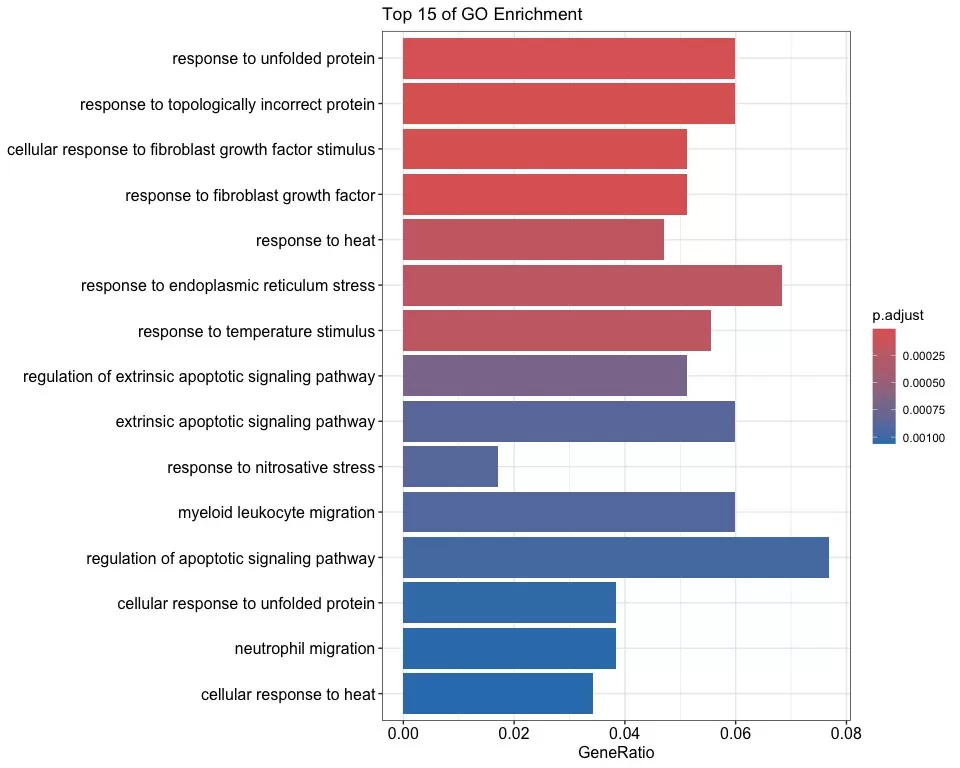
GO Enrichment Bar Plot
In addition to demonstrating the degree of enrichment, the bubble plot also reflects the number of genes involved in that GO term by the bubble size, which indicates the significance level by the color, enabling us to understand the results of the GO enrichment analysis in a more comprehensive way.
dotplot(enrichFrame,
x = "GeneRatio",
color = "p.adjust",
title = "Top 15 of GO Enrichment",
showCategory = 15,
label_format = 80
)
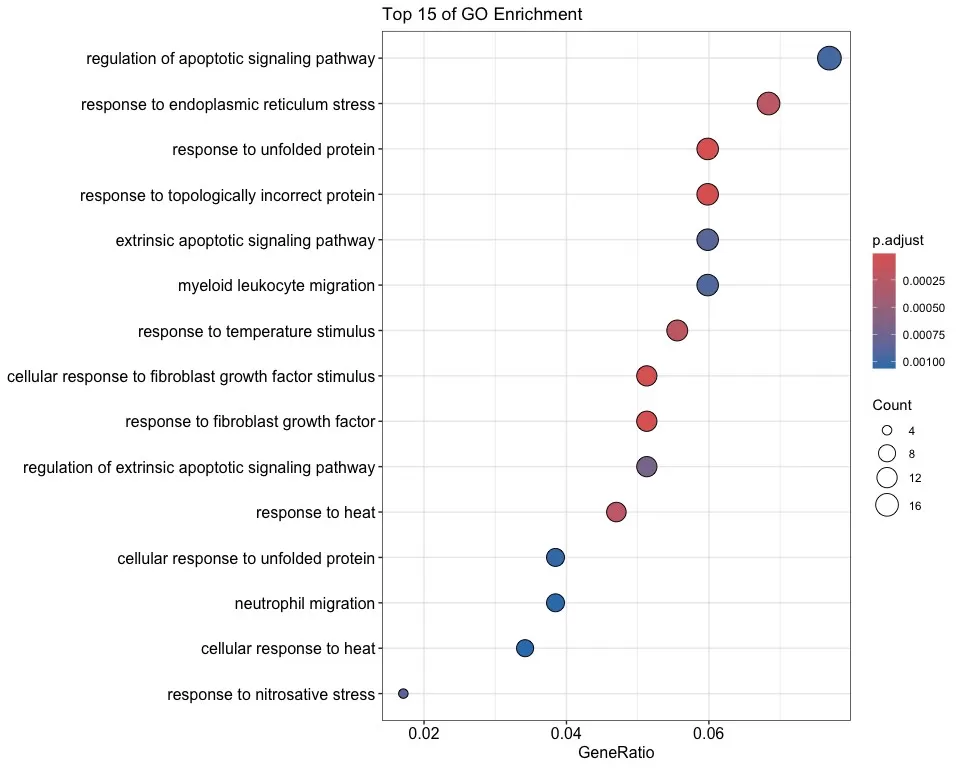
GO enrichment bubble plot
How to Turn GO Enrichment Results into Biological Insights
Significantly enriched terms (e.g., p.adjust < 0.05) reveal key biological themes. For instance, enrichment in "regulation of apoptosis" (GO:0042981) suggests DEGs modulate cell death pathways. Cross-referencing with literature or pathway databases (e.g., KEGG, Reactome) strengthens mechanistic hypotheses.
GO enrichment analysis is best suited for summarizing the functional themes behind a gene or protein list. KEGG or Reactome enrichment is often more useful when the goal is to interpret pathway-level mechanisms, while GSEA is preferred when genes can be ranked across the full dataset rather than filtered into a significant list. In practice, researchers often use GO enrichment to identify functional categories, KEGG or Reactome to examine pathway mechanisms, and multi-omics integration to connect transcriptomic or proteomic signals with metabolite-level phenotypes.
Table 4. GO Enrichment vs KEGG/Reactome vs GSEA
|
Method |
Best input |
Best use case |
Common limitation |
|
GO enrichment |
A DEG or differential protein list |
Summarize biological processes, molecular functions, and cellular components |
GO terms can be broad or redundant. |
|
A gene/protein list mapped to pathways |
Interpret pathway-level mechanisms and pathway maps |
Coverage depends on pathway database annotation. |
|
|
A ranked gene list |
Detect coordinated pathway-level changes without a hard cutoff |
Requires careful ranking direction and interpretation. |
|
|
Multi-omics integration |
Multiple omics layers such as transcriptomics, proteomics, and metabolomics |
Connect functional enrichment with metabolite/protein phenotypes |
Requires consistent study design and cross-layer interpretation. |
No-Code and Multi-Omics Options for GO/KEGG Enrichment: Metware Cloud Platform
For researchers lacking programming expertise, Metware Cloud Platform offers a user-friendly interface for GO/KEGG enrichment, GSEA, and differential expression analysis. Key features include:
- No-Code Analysis: Upload data, select parameters, and generate reports via GUI.
- Advanced Visualization: Interactive heatmaps, network diagrams, and pathway maps.
- Multi-Omics Integration: Combine transcriptomic, proteomic, and metabolomic data.
FAQ About GO Enrichment Analysis
What is GO enrichment analysis used for?
GO enrichment analysis is used to identify Gene Ontology terms that appear more often than expected in a gene or protein list. It helps researchers summarize biological processes, molecular functions, or cellular components associated with differentially expressed genes, proteins, or other omics-derived candidate lists.
What is the difference between BP, MF, and CC in GO enrichment?
Biological Process (BP) describes broader biological programs such as immune response or cell cycle regulation. Molecular Function (MF) describes molecular activities such as binding or catalytic activity. Cellular Component (CC) describes where gene products act, such as the nucleus, mitochondrion, or plasma membrane.
Why is the background gene list important in GO enrichment analysis?
The background gene list defines what genes were actually detectable or tested in the experiment. Using an inappropriate background, such as the entire genome when only a subset of genes was measured, can distort enrichment statistics and lead to misleading biological interpretation.
What is the difference between GeneRatio and BgRatio?
GeneRatio describes the proportion of input genes associated with a GO term, while BgRatio describes the proportion of background genes associated with that term. Comparing these values helps researchers understand whether a GO term is overrepresented in the input list relative to the tested background.
When should I use GO enrichment instead of GSEA?
Use GO enrichment when you have a defined list of significant genes or proteins, such as DEGs after differential expression analysis. Use GSEA when you have a ranked gene list and want to test whether predefined gene sets are enriched toward the top or bottom of the ranking.
Can GO enrichment analysis be used for proteomics data?
Yes. GO enrichment analysis can be applied to differentially abundant proteins if the protein identifiers are mapped to appropriate gene or protein annotation databases. This is commonly used in quantitative proteomics to summarize functional changes and generate pathway-level hypotheses.
From GO Enrichment to Multi-Omics Interpretation
GO enrichment analysis is often an early step in turning gene or protein lists into biological hypotheses. For studies that combine transcriptomics, proteomics, metabolomics, or other omics layers, enrichment results can be interpreted alongside pathway activity, metabolite changes, and phenotype-relevant molecular signatures. MetwareBio supports multi-omics data analysis by helping researchers connect functional enrichment results with integrated omics evidence and downstream biological interpretation.
Read more
- Multi-Omics Association Analysis Series
- Omics Data Processing Series
- Understanding WGCNA Analysis in Publications
- Deciphering PCA: Unveiling Multivariate Insights in Omics Data Analysis
- Metabolomic Analyses: Comparison of PCA, PLS-DA and OPLS-DA
- WGCNA Explained: Everything You Need to Know
- Harnessing the Power of WGCNA Analysis in Multi-Omics Data
- Beginner for KEGG Pathway Analysis: The Complete Guide
- GSEA Enrichment Analysis: A Quick Guide to Understanding and Applying Gene Set Enrichment Analysis
- Comparative Analysis of Venn Diagrams and UpSetR in Omics Data Visualization