Plant roots do not grow through soil passively. They continuously sense moisture, nutrients, microbes, physical barriers, chemical gradients, and local stress signals to adjust growth direction. A recent Science project article, Roots navigate around decay regions by sensing local pH gradients, reported a newly described root growth response called saprotropism, in which roots bend away from decaying plant-derived matter by sensing local pH gradients (Bao et al., 2026). In this project, MetwareBio provided non-targeted metabolomics testing support. Starting from this study, this article discusses how plant metabolomics and multi-omics can help researchers investigate root-microbe-soil communication, chemical signaling, hormone response, and root adaptation in complex soil environments.
Key Takeaways
- A Science project article reported saprotropism, a root growth response in which roots avoid decay-associated regions by sensing local pH gradients.
- Non-targeted metabolomics can help profile decay- and rhizosphere-associated small molecules, supporting hypothesis generation for root-soil interaction studies.
- Integrating metabolomics with plant hormone profiling, transcriptomics, proteomics, imaging, and spatial omics can help connect soil chemical cues with root phenotypes.
Why Root Navigation Requires a Multi-Omics View
Root systems grow through highly heterogeneous soil. Even within a few millimeters, roots can encounter different pH levels, moisture conditions, oxygen availability, microbial communities, nutrient concentrations, and organic matter states. Classical root tropisms, such as gravitropism and hydrotropism, explain how roots respond to directional physical or environmental cues. However, modern plant biology increasingly shows that root behavior is also shaped by chemically complex microenvironments.
Root exudates and rhizosphere metabolites are central to this interaction. Plants release amino acids, organic acids, sugars, phenolics, flavonoids, peptides, and specialized metabolites into the rhizosphere. These molecules can influence microbial recruitment, nutrient cycling, stress adaptation, and soil chemistry (Salem et al., 2022; McLaughlin et al., 2023). At the same time, microbes and decomposing organic matter also release metabolites that reshape the local chemical environment.
This means root navigation cannot be fully explained by a single data layer. Researchers need to connect chemical cues, hormone pathways, sensing mechanisms, tissue-level localization, and visible root phenotypes. Plant metabolomics is essential because it provides a broad view of the small-molecule environment in which these biological decisions occur.
Featured Project Article: Roots Navigate Around Decay Regions by Sensing Local pH Gradients
The featured project article in Science investigated how roots respond to decay regions in soil and reported saprotropism as a previously unrecognized root growth response (Bao et al., 2026). The study showed that roots can actively bend away from decaying plant-derived matter before direct contact occurs.
The proposed mechanism begins with microbial decomposition. Fungal-driven decay releases organic acids that form stable local acidic pH gradients around decomposing plant material. Roots sense this pH asymmetry through root epidermal cells and the root meristem growth factor peptide-receptor module. This external pH signal is then converted into asymmetric ABA distribution, followed by microtubule reorganization and directional root bending (Bao et al., 2026).
This study is important because it turns a local soil chemistry phenomenon into a biological signaling model. Decaying organic matter is not only a nutrient source. It can also create microbially active and potentially unfavorable niches. By sensing pH gradients generated during decomposition, roots appear to use local chemical information to navigate around these regions.
For plant metabolomics, this project illustrates a broader solution concept: when the biological signal is unknown or chemically complex, non-targeted metabolomics can help profile the local small-molecule environment and identify candidate chemical drivers for further validation.
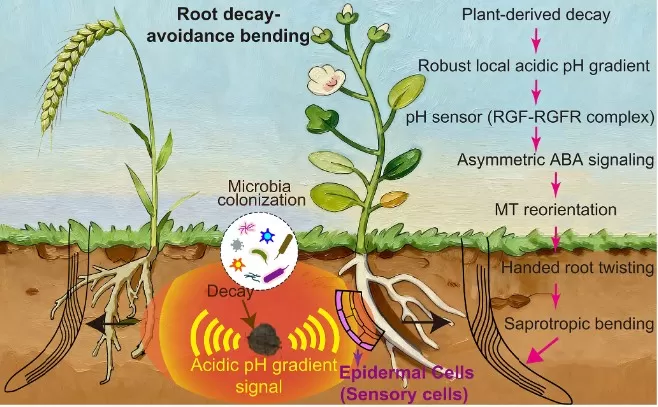
Figure 1. Saprotropism links decay-derived pH gradients with root avoidance behavior. Decay-derived organic acids can form local acidic pH gradients around decomposing plant material. Roots sense this asymmetry and convert it into hormone and cellular responses that guide root bending away from decay regions. Adapted conceptually from Bao et al., 2026.
What Is Saprotropism?
Saprotropism is a root growth response in which plant roots bend away from decaying plant-derived matter by sensing chemical gradients produced during microbial decomposition (Bao et al., 2026).
This concept adds a new layer to root-microbe-soil communication. Roots are not only attracted toward water or nutrients; they can also avoid chemically or biologically challenging microsites. In saprotropism, decay-derived signals act as environmental information that roots can interpret and translate into directional growth.
Why Soil Chemical Gradients Matter in Plant Biology
Soil is chemically dynamic. Microbial decomposition, root exudation, nutrient mobilization, organic acid release, and microbial metabolism can create small-scale chemical gradients that are difficult to capture using bulk measurements alone. Local pH gradients are especially important because pH affects nutrient availability, microbial activity, metal solubility, organic acid behavior, and root physiology.
Recent root exudate and rhizosphere studies have shown that root-derived metabolites are dynamic and strongly influenced by species, growth conditions, microbial status, sampling time, and environmental context (McLaughlin et al., 2023; Salem et al., 2022). In non-sterile systems, microbial metabolism further modifies the metabolite profile, making the rhizosphere a mixed chemical environment shaped by both plant and microbial activity.
The featured Science article extends this logic to decay regions. Instead of focusing only on molecules released by living roots, it highlights how decaying plant material and fungal decomposition generate external chemical gradients that roots can sense (Bao et al., 2026). For studies of plant adaptation, researchers should not treat soil chemistry as a static background variable. It can be an active signaling layer.
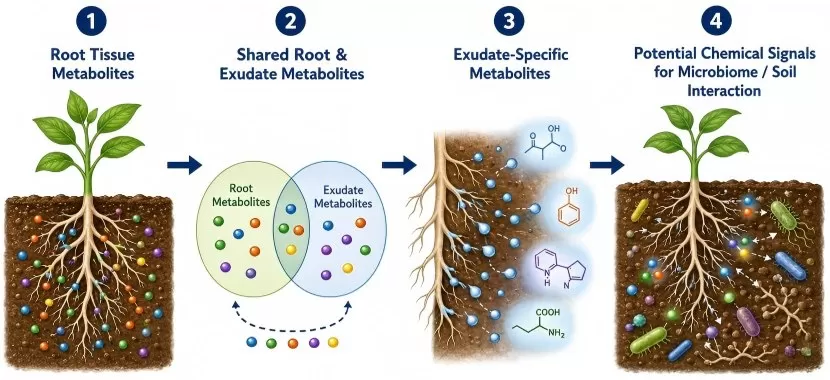
Figure 2. Root and exudate metabolomes provide chemical context for root-soil communication. Root and exudate metabolomes contain shared and environment-responsive metabolites that may contribute to plant-microbe-soil communication. Adapted from McLaughlin et al., 2023 under CC BY 4.0.
How Non-Targeted Metabolomics Supports Root-Soil Interaction Research
Non-targeted metabolomics is useful when researchers need broad discovery of small molecules without limiting the analysis to a predefined panel. This is especially relevant in root-soil interaction studies because many chemical cues may be unknown, transient, microbe-derived, or condition-specific.
In studies involving decay regions, root exudates, or rhizosphere microsites, non-targeted metabolomics can help researchers:
- Profile small molecules released during microbial decomposition.
- Compare decay regions, surrounding soil, root-adjacent soil, and control conditions.
- Detect organic acids and other metabolites associated with pH shifts.
- Identify candidate chemical cues involved in root navigation.
- Compare plant genotypes, microbial conditions, stress treatments, or soil environments.
- Generate hypotheses for targeted validation, hormone analysis, transcriptomics, proteomics, or functional experiments.
Recent studies continue to improve root exudate and rhizosphere metabolomics workflows. For example, non-targeted profiling has been used to characterize root exudation dynamics across plant species and growth conditions (McLaughlin et al., 2023). Other recent work has emphasized that root exudate composition can shape plant-microbiome interactions and stress resistance, supporting the idea that small molecules are central to belowground communication (Afridi et al., 2024).
In a solution workflow, metabolomics functions as the discovery layer. It helps researchers identify what chemical signals may be present, after which targeted assays, plant hormone profiling, molecular biology, and phenotype analysis can test which signals are functionally important.
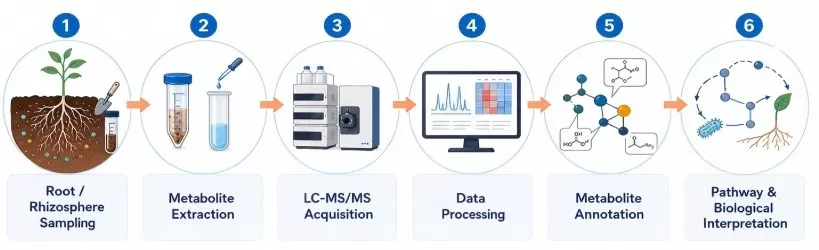
Figure 3. Non-targeted metabolomics workflow for root-soil interaction studies. A root and rhizosphere metabolomics workflow can include sample collection, extraction, LC-MS/MS data acquisition, metabolite annotation, statistical analysis, and biological interpretation. Adapted from Salem et al., 2022 under CC BY.
From Metabolites to Hormones: Connecting External Cues with Internal Response
The featured Science study did not stop at identifying an external pH gradient. It linked external chemical asymmetry with internal ABA asymmetry, microtubule reorganization, and root bending (Bao et al., 2026). This is a useful model for how plant multi-omics studies can move from environmental signals to biological mechanism.
A metabolite gradient alone does not fully explain root bending. Similarly, gene expression alone cannot reveal the chemical microenvironment that triggered the response. A practical interpretation requires chemical information from the soil or decay region, hormone distribution, gene and protein pathway evidence, imaging, and root phenotyping. Multi-omics integration helps connect cause, response, and phenotype without relying on a single measurement layer.
A Practical Multi-Omics Workflow for Root Navigation Studies
A practical multi-omics workflow for root navigation studies usually starts with a clearly defined biological question, followed by non-targeted metabolomics to capture the chemical environment, plant hormone profiling to assess internal signaling, transcriptomics or proteomics for pathway interpretation, and imaging or phenotyping to link molecular signals with root behavior. Candidate signals from discovery-based metabolomics should then be validated through targeted quantification, chemical treatment, mutant analysis, microbial manipulation, pH control experiments, or functional assays.
Research Applications Beyond Saprotropism
Although the featured project article focuses on roots avoiding decay regions, the solution framework applies to many plant biology questions.
Root-microbe communication
Root exudates can shape microbial communities by acting as nutrients or signals. Metabolomics can help characterize the chemical profile of root exudates and rhizosphere metabolites, while microbiome analysis reveals how microbial communities respond (McLaughlin et al., 2023; Afridi et al., 2024).
Plant stress adaptation
Abiotic and biotic stresses can alter root metabolism, exudation, hormone signaling, and microbial recruitment. Multi-omics approaches can help connect stress-associated metabolites with transcripts, proteins, hormones, and phenotypes (Choudhary et al., 2023).
Rhizosphere metabolome discovery
The rhizosphere contains plant-derived, microbe-derived, and soil-derived metabolites. Recent work has highlighted the importance of untangling specialized metabolites in the rhizosphere and understanding their ecological roles (Genesiska et al., 2025).
Crop root trait research
Root architecture and rhizosphere interactions are increasingly important for improving nutrient use, drought adaptation, and soil resilience. Metabolomics can help identify chemical traits associated with root performance, microbial recruitment, or stress tolerance.
Spatial plant biology
When the location of molecular changes matters, spatial metabolomics can add tissue context. This is especially relevant for root tips, meristems, vascular tissues, hormone gradients, and localized stress responses.
Suggested Study Design Matrix
| Research goal | Recommended omics strategy | What it can reveal |
|---|---|---|
| Identify decay-associated chemical cues | Non-targeted metabolomics of decay regions and controls | Organic acids, small molecules, and candidate pH-associated signals |
| Study root response to soil chemical gradients | Metabolomics + pH mapping + root phenotyping | Links between local chemistry and root bending behavior |
| Connect chemical cues with hormone response | Metabolomics + plant hormone profiling | How external signals may alter ABA or other hormone pathways |
| Explore molecular mechanisms | Transcriptomics + proteomics + metabolomics | Genes, proteins, pathways, and metabolites involved in root response |
| Study root-microbe-soil interactions | Metabolomics + microbiome profiling | Chemical drivers of microbial recruitment or microbial activity |
| Add tissue-level context | Spatial metabolomics + imaging | Where molecular changes occur in root tissues |
FAQ: Plant Metabolomics and Root Navigation
What is saprotropism?
Saprotropism is a root growth response in which roots bend away from decaying plant-derived matter by sensing chemical gradients produced during microbial decomposition. The featured Science study showed that decay-derived acidic pH gradients can guide root avoidance behavior (Bao et al., 2026).
How can metabolomics help study root navigation?
Metabolomics helps study root navigation by identifying small molecules in root, soil, decay, or rhizosphere samples. It can reveal candidate chemical cues, such as organic acids or stress-associated metabolites, that may influence root growth direction and plant-soil communication.
Why are root exudates important in plant-microbe-soil research?
Root exudates are important because they contain metabolites that can shape microbial communities, nutrient cycling, and plant stress responses. Their composition can vary by plant species, growth condition, microbial status, and sampling time, making metabolomics essential for accurate chemical profiling (Salem et al., 2022; McLaughlin et al., 2023).
When should researchers use non-targeted metabolomics?
Researchers should use non-targeted metabolomics when the chemical signals are unknown or when the goal is broad discovery. It is especially useful for comparing root exudates, rhizosphere soil, decay regions, stress treatments, plant genotypes, or microbial conditions.
Can plant metabolomics be combined with hormone analysis?
Yes. Plant metabolomics can be combined with hormone profiling to connect external chemical cues with internal signaling responses. For root navigation studies, this can help link soil metabolites or pH gradients with ABA, auxin, jasmonate, salicylic acid, or other plant hormone pathways.
How does multi-omics improve root-soil interaction research?
Multi-omics improves root-soil interaction research by connecting chemical signals, gene expression, protein regulation, hormone changes, spatial organization, and root phenotypes. This helps researchers move from descriptive observation to mechanism-oriented interpretation.
Conclusion
The Science project article on saprotropism provides a strong example of how root behavior can be guided by local chemical gradients generated in complex soil environments. By showing that roots can sense decay-derived pH gradients and translate them into ABA asymmetry, microtubule reorganization, and root bending, the study expands how researchers think about root-microbe-soil communication (Bao et al., 2026).
More broadly, this direction highlights the value of plant metabolomics and multi-omics. Non-targeted metabolomics can help profile chemical environments and prioritize candidate cues for validation. Hormone profiling, transcriptomics, proteomics, imaging, spatial omics, and phenotyping can then help explain how those cues are sensed and converted into biological responses.
For plant scientists studying root adaptation, stress response, rhizosphere chemistry, or plant-microbe interactions, multi-omics provides a solution framework for moving from environmental complexity to mechanistic understanding.
How MetwareBio Supports Plant Metabolomics and Multi-Omics Research
For studies involving root navigation, rhizosphere chemistry, plant stress response, hormone signaling, or root-microbe interactions, MetwareBio supports researchers with multi-omics workflows designed to connect environmental chemical cues with plant physiological responses.
Depending on the research question, relevant solutions may include non-targeted metabolomics for broad small-molecule discovery, plant hormone profiling for signaling analysis, proteomics for pathway interpretation, spatial metabolomics for tissue-level molecular distribution, and integrated multi-omics analysis.
For researchers planning plant metabolomics or root-soil interaction studies, MetwareBio can help discuss sample type, study design, analytical strategy, and data interpretation needs.
Contact UsRead More
Explore these related articles on plant metabolomics, multi-omics integration, and spatial analysis to deepen your understanding of root-soil interactions and plant adaptation research.
Learn how integrating metabolomics, proteomics, and transcriptomics reveals color development, stress tolerance, and fruit development mechanisms in tomato research.
A practical overview of specialized metabolite detection methods and their applications in plant biology, stress response, and rhizosphere chemical communication studies.
Understand how combined transcriptome and metabolome analysis reveals drought stress adaptation mechanisms, relevant to root navigation and soil chemical gradient research.
A comprehensive guide to spatial metabolomics resolution choices for plant tissue imaging, directly applicable to root tip and meristem molecular distribution studies.
Discover how multi-omics approaches in plant science connect molecular profiles with agricultural traits, supporting root-microbe-soil interaction research.
Learn about MetwareBio's expanded plant metabolomics database, enhancing coverage for root exudates, rhizosphere metabolites, and specialized plant metabolite profiling.
References
- Afridi, M. S., Kumar, A., Javed, M. A., Dubey, A., de Medeiros, F. H. V., & Santoyo, G. (2024). Harnessing root exudates for plant microbiome engineering and stress resistance in plants. Microbiological Research, 279, 127564. https://doi.org/10.1016/j.micres.2023.127564
- Bao, Z., Wang, H., Zhang, A., Gao, R., Gu, W., Fan, N., Friml, J., & Zhang, Y. (2026). Roots navigate around decay regions by sensing local pH gradients. Science, 393(6807), eadw6568. https://doi.org/10.1126/science.adw6568
- Bhimani, P., Mahavar, P., Rajguru, B., Bhatt, V. D., & Nathani, N. M. (2024). Unveiling the green dialogue: advancements in omics technologies for deciphering plant-microbe interactions in soil. Discover Plants, 1, 4. https://doi.org/10.1007/s44372-024-00004-3
- Choudhary, D. K., et al. (2023). Multi-omics approaches for understanding stressor-induced physiological changes in plants: An updated overview. Physiological and Molecular Plant Pathology, 126, 102047. https://doi.org/10.1016/j.pmpp.2023.102047
- Genesiska, Salles, J. F., & Tiedge, K. J. (2025). Untangling the rhizosphere specialized metabolome. Phytochemistry Reviews, 24, 2527-2537. https://doi.org/10.1007/s11101-024-10036-y
- McLaughlin, S., Zhalnina, K., Kosina, S., Northen, T. R., et al. (2023). The core metabolome and root exudation dynamics of three phylogenetically distinct plant species. Nature Communications, 14, 1649. https://doi.org/10.1038/s41467-023-37164-x
- Salem, M. A., Wang, J. Y., & Al-Babili, S. (2022). Metabolomics of plant root exudates: From sample preparation to data analysis. Frontiers in Plant Science, 13, 1062982. https://doi.org/10.3389/fpls.2022.1062982
- Simmons, T., Styer, A. B., Pierroz, G., et al. (2020). Drought drives spatial variation in the millet root microbiome. Frontiers in Plant Science, 11, 599. https://doi.org/10.3389/fpls.2020.00599