Short-Chain Fatty Acids
Short-Chain Fatty Acid (SCFA) Quantification by GC-MS/MS
| Specification | MetwareBio SCFA Assay |
|---|---|
| Analytical Platform | Targeted GC-MS/MS |
| Instrument | Agilent 8890–7000D GC-MS/MS system |
| Target Analytes | 17 short-, branched-chain, and selected medium-chain fatty acids |
| Acquisition Mode | Triple-quadrupole multiple reaction monitoring (MRM) |
| Quantification Method | Absolute quantification |
| Calibration | 17 analyte-specific calibration curves with internal-standard correction (r > 0.99) |
Why Choose MetwareBio for SCFA Targeted Metabolomics?
Broad 17-Analyte Fatty Acid Coverage
Accurate Absolute Quantification
Sensitive and Selective GC-MS/MS Detection
Reproducible Data with Standardized Quality Control
Multi-Omics Integration for Deeper Biological Insight
Short-Chain and Medium-Chain Fatty Acid Coverage
MetwareBio’s Short-Chain Fatty Acid Targeted Panel provides targeted quantification of 17 low-molecular-weight fatty acids in a single assay, including major straight-chain SCFAs, branched-chain SCFAs, and selected medium-chain fatty acids. This expanded coverage enables broader profiling of microbial and host fatty acid metabolism beyond the major SCFAs acetate, propionate, and butyrate.
| Fatty Acid Class | Target Analytes |
| Straight-Chain SCFAs (C2–C6) | Acetic acid, propionic acid, butyric acid, valeric acid, caproic acid |
| Branched-Chain SCFAs (C4–C6) | Isobutyric acid, isovaleric acid, 2-methylbutyric acid, isocaproic acid |
| Medium-Chain Fatty Acids (C7–C10) | Isoheptanoic acid, 2-ethylcaproic acid, heptanoic acid, 3,5,5-trimethylhexanoic acid, octanoic acid, nonanoic acid, isodecanoic acid, decanoic acid |
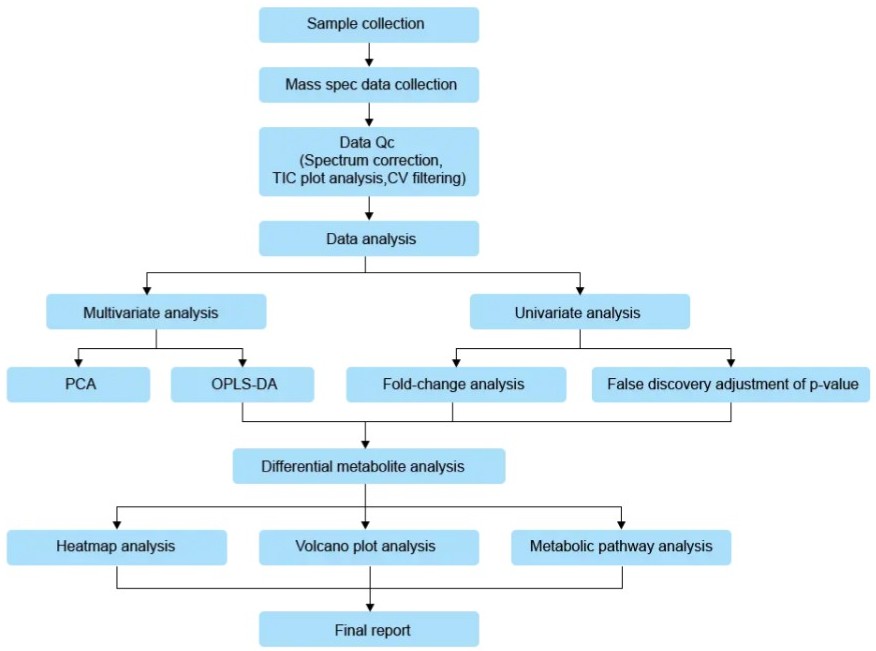
Project Workflow for GC-MS/MS SCFA Quantification




Quantification

Step-by-Step Workflow of MetwareBio’s Short-Chain Fatty Acid Targeted Metabolomics
SCFA Data Analysis and Deliverables
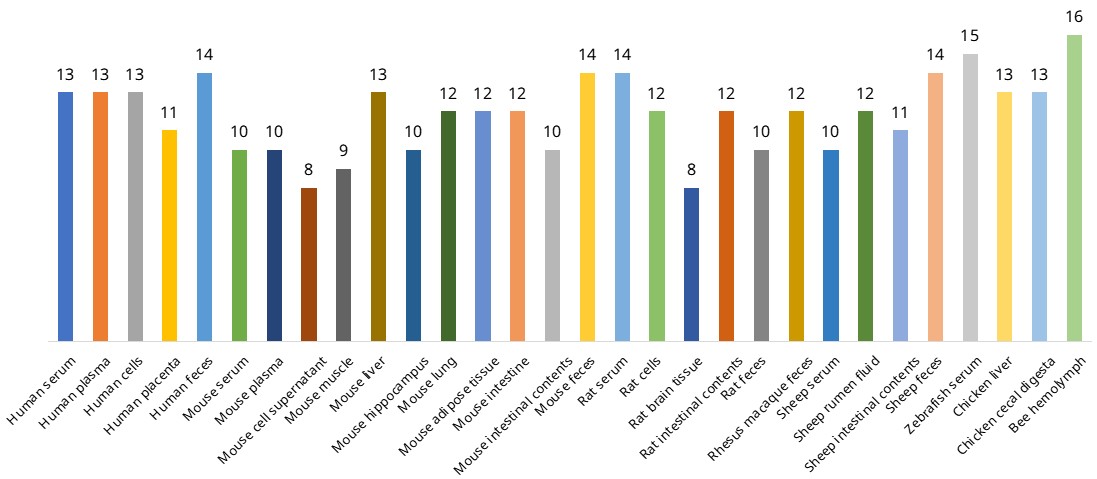
Proven Experience in Targeted SCFA Profiling
Applications of Short-Chain Fatty Acid (SCFA) Profiling
Gut Microbiome and Host–Microbe Interactions
SCFA quantification helps characterize gut microbial metabolic activity and its interaction with host physiology. Measuring acetate, propionate, butyrate, and related fatty acids can link changes in microbiome composition or function with microbial fermentation output, host metabolic responses, and physiological phenotypes, supporting studies of microbiome–metabolite–host relationships across diverse biological models.
Nutrition and Dietary Intervention Studies
Short-chain fatty acid profiling helps assess metabolic responses to dietary fiber, prebiotics, probiotics, functional foods, and other nutritional interventions. Quantitative SCFA data can reveal changes in microbial fermentation output, support comparisons between dietary groups, and help researchers evaluate how nutritional strategies influence gut-derived metabolites and host metabolic responses.
Metabolic Health and Energy Metabolism
SCFAs are closely connected with glucose regulation, lipid metabolism, hepatic metabolism, and whole-body energy homeostasis. Targeted SCFA quantification can support research on obesity, insulin resistance, metabolic syndrome, and related metabolic disorders by providing concentration-based data for evaluating metabolic phenotypes, treatment effects, and associations between microbial metabolites and host energy metabolism.
Gastrointestinal Health and Immune Regulation
SCFA analysis is widely used in studies of intestinal barrier function, mucosal homeostasis, gastrointestinal inflammation, and immune regulation. Quantifying acetate, propionate, butyrate, and related fatty acids can help characterize metabolic changes associated with intestinal disorders, host–microbe interactions, and experimental interventions targeting gut barrier integrity or immune-related phenotypes.
Published Case Study in SCFA Targeted Metabolomics
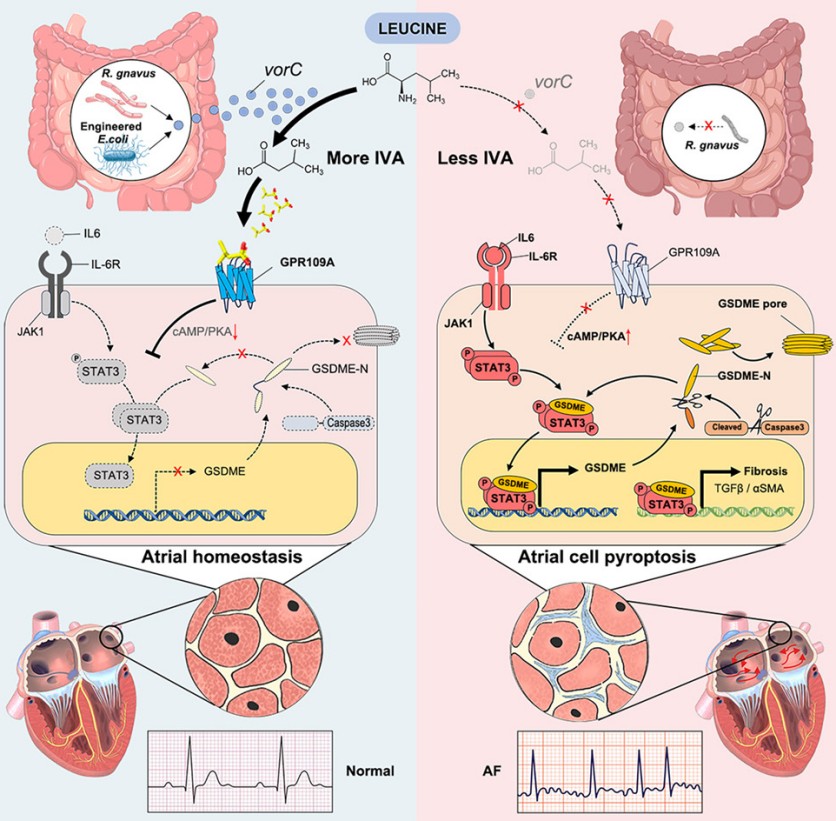
SCFA Quantification Links Microbiota-Derived Isovaleric Acid to Atrial Fibrillation
In a 2026 Cell Metabolism study, “Gut microbiota-derived isovaleric acid alleviates atrial fibrillation by suppressing GSDME-dependent pyroptosis”, Ding et al. showed that Ruminococcus gnavus converts dietary leucine into isovaleric acid (IVA), which reduced atrial fibrillation susceptibility and fibrosis through GPR109A-mediated suppression of the STAT3–GSDME pyroptosis pathway. MetwareBio provided targeted SCFA quantification, showing that serum IVA was decreased in atrial fibrillation cohorts, positively associated with R. gnavus abundance, and increased following R. gnavus colonization and leucine metabolism in experimental models. These quantitative SCFA data helped identify and validate IVA as a key microbial metabolite linking gut microbiome function with atrial fibrillation biology and downstream mechanistic findings. Explore more MetwareBio-supported SCFA publications.
Sample Requirements for SCFA Analysis
| Sample Type | Recommended Input | Minimum Input | Biological Replicates | Storage & Shipping |
| Plasma / Serum | 100 µL | 50 µL | ≥3/group; 30+ human / 8–10 animal | Snap-frozen in liquid nitrogen for 5–10 min immediately after collection, stored at −80 °C, and shipped on sufficient dry ice. |
| Feces / Intestinal Contents | 200 mg | 20 mg | ≥3/group; 30+ human / 8–10 animal | |
| Tissue | 100 mg | 20 mg | ≥3/group; 30+ human / 8–10 animal | |
| Cells / Animal Cell Lines | 1 × 10⁶ cells | 5 × 10⁵ cells | ≥3 biological replicates/group | |
| Culture Supernatant / Fermentation Broth | 100 µL | 50 µL | ≥3 biological replicates/group | |
| Rumen Fluid | 500 µL | 50 µL | ≥3/group; 8–10 recommended |
Note: For other sample types or uncommon matrices, please refer to our Sample Requirements page for general guidance and contact MetwareBio for project-specific feasibility evaluation.
Frequently Asked Questions About SCFA Quantification
1. What does the MetwareBio SCFA targeted metabolomics panel measure?
MetwareBio’s SCFA panel absolutely quantifies 17 low-molecular-weight fatty acids, including major straight-chain SCFAs, branched-chain SCFAs, and C7–C10 medium-chain fatty acids. The panel extends beyond acetate, propionate, and butyrate to provide broader targeted coverage of microbial and host fatty acid metabolism.
2. When should I choose targeted SCFA quantification instead of untargeted metabolomics?
Targeted SCFA quantification is preferred when the study specifically requires accurate concentration measurements of predefined short-chain fatty acids. Unlike untargeted metabolomics, which prioritizes broad metabolite discovery, the SCFA assay uses calibration standards and internal-standard correction to provide absolute concentration data for defined target compounds.
3. How are SCFAs absolutely quantified by GC-MS/MS?
Target fatty acids are separated by gas chromatography and detected using triple-quadrupole GC-MS/MS in multiple reaction monitoring (MRM) mode. Absolute concentrations are calculated using analyte-specific multi-point calibration curves with internal-standard correction, allowing quantitative comparison across samples and experimental groups.
4. Why is GC-MS/MS used for short-chain fatty acid analysis?
SCFAs are small and relatively volatile molecules that are well suited to gas chromatographic separation. Coupling GC with triple-quadrupole MRM provides selective detection of structurally related fatty acids and supports reliable quantitative analysis in complex biological matrices.
5. What sample types can be used for SCFA quantification?
The SCFA assay is compatible with diverse biological matrices, including serum, plasma, feces, intestinal contents, tissues, cells, culture supernatants, rumen fluid, and other biological samples. Required input and sample preparation vary by matrix and should be confirmed before sample submission.
6. How should fecal samples be collected and submitted for SCFA analysis?
For fecal or intestinal-content samples, collect representative material into clean tubes using a consistent sampling procedure across all study groups. Approximately 200 mg is recommended, with 20 mg as the minimum input. After collection, snap-freeze samples in liquid nitrogen for 5–10 minutes, store them at −80 °C, and ship on sufficient dry ice. Avoid adding preservatives unless their compatibility with SCFA quantification has been confirmed. If fecal samples have already been stored in a nucleic acid preservation solution, please contact MetwareBio for pre-sales evaluation to determine whether SCFA analysis is feasible.
7. How should biological samples for SCFA analysis be collected and stored?
Samples should be collected consistently across experimental groups, snap-frozen in liquid nitrogen for 5–10 minutes after collection, stored at −80 °C, and shipped on sufficient dry ice. Consistent pre-analytical handling is important for minimizing variation unrelated to the biological question.
8. What results and data analysis are included in an SCFA project?
Typical deliverables include an absolute concentration matrix, analyte-specific calibration data, analytical quality-control results, and a final analysis report. Data analysis can include quality assessment, group comparison, visualization, differential metabolite screening, and KEGG pathway analysis when supported by the study design and differential metabolite results.
9. Can SCFA quantification be integrated with microbiome or other omics data?
Yes. SCFA concentration data can be integrated with 16S rRNA sequencing, metagenomics, transcriptomics, or proteomics datasets to investigate relationships among microbial composition and function, metabolite production, host pathways, and biological phenotypes.
Reference
Ding, N., Wu, H., Hua, Y., Hua, R., Li, B., Xie, Y., Xiong, Y., Bai, T., Shi, X., Shen, T., Liu, P., Liu, J., Yang, X., Xu, Y., Meng, Z., Lan, B., Zhou, J., Liu, B., Shyy, J. Y., Yuan, Z., … Li, T. (2026). Gut microbiota-derived isovaleric acid alleviates atrial fibrillation by suppressing GSDME-dependent pyroptosis. Cell Metabolism, 38(2), 370–387.e10. https://doi.org/10.1016/j.cmet.2025.12.017