Metabolomics is the systematic study of small molecules-metabolites-in cells, tissues, biofluids, organisms, and other biological systems. By measuring how metabolite patterns change across conditions, it provides a direct view of biochemical activity and phenotype. The results, however, depend on sampling, extraction, analytical platform, and data processing, so a metabolomics dataset represents a defined analytical window rather than the complete metabolome. This guide explains the metabolome and measured metabolome, distinguishes profiling, fingerprinting, and footprinting, compares untargeted, targeted, and widely targeted metabolomics, and outlines the evidence needed for reliable biological interpretation.
1. Metabolomics Definition: Metabolites, the Metabolome, and the Measured Metabolome
Metabolomics is the systematic measurement and interpretation of metabolites—the small molecules that participate in or result from biochemical reactions. These include substrates, intermediates, products, cofactors, and signaling molecules involved in energy metabolism, biosynthesis, redox regulation, transport, and cellular communication. Depending on the study, the measured chemical space may also include drugs, dietary compounds, environmental exposures, and their transformation products. The metabolome is the set of metabolites present in or associated with a defined biological system at a specific time and under specified conditions (Fiehn, 2002).
Unlike the genome, the metabolome changes rapidly with biological and environmental context. Species, tissue, cell type, developmental stage, diet, medication, disease status, circadian timing, microbiome activity, and sample collection can all alter the observed metabolic state. Metabolomics is therefore not a single instrument or protocol; it is a workflow that integrates study design, sample handling, analytical chemistry, data processing, metabolite annotation, statistics, and biological interpretation.
Most experiments capture only a subset of the biological metabolome. This measured metabolome is shaped by the sample matrix, extraction method, chromatographic or spectroscopic separation, ionization, detector sensitivity, acquisition settings, and data-processing workflow. LC-MS, GC-MS, and NMR provide complementary coverage, and no single platform detects every metabolite. Accordingly, global or comprehensive metabolomics should refer to broad, reproducible coverage within a defined workflow—not complete measurement of the entire metabolome (Alseekh et al., 2021). Figure 1 summarizes this study process.
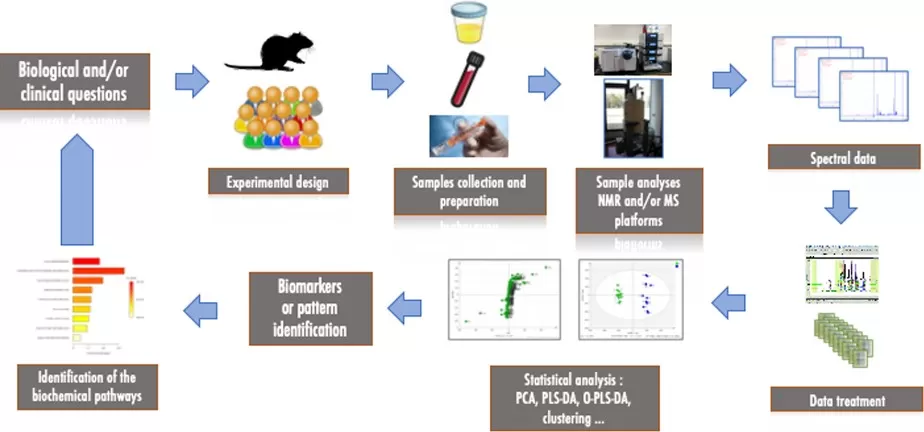
Figure 1. General metabolomics workflow from study design to biological interpretation. Reproduced from Figure 2 in Letertre et al. (2021), Frontiers in Molecular Biosciences, under CC BY 4.0; resized for layout with no content changes.
2. Key Metabolomics Terms: Profiling, Fingerprinting, Footprinting, and Target Analysis
Several familiar terms describe different parts of a metabolomics study, which is why they are often confused. Profiling and fingerprinting concern analytical scope or the form of the output; footprinting refers to extracellular samples; and target analysis refers to a predefined analyte set. None of these terms is a direct synonym for untargeted, targeted, or widely targeted metabolomics.
2.1 Metabolic Profiling vs. Fingerprinting: Metabolite Identities and Global Signal Patterns
Metabolic profiling emphasizes the characterization of a related group or a relatively broad set of metabolites. The objective is usually to describe metabolic composition and compare changes across conditions. Biological interpretation generally depends on annotated or identified metabolites, although the quantitative level may range from relative abundance to semiquantitative estimates or calibrated absolute concentrations. A profile may focus on a pathway, a chemical class, or a broader cross-section of metabolism.
Metabolic fingerprinting places greater emphasis on the overall spectral or chromatographic pattern. The primary goal is often sample classification, discrimination, authentication, or quality assessment rather than identification of every contributing signal. A metabolic fingerprint is the resulting pattern, whereas fingerprinting is the strategy used to generate and compare that pattern. Fingerprinting frequently uses data acquired through untargeted methods, also termed nontargeted in some analytical literature, but it is not a synonym for untargeted metabolomics because the defining feature is the pattern-based objective, not the acquisition mode (Fiehn, 2002; Liu et al., 2022).
2.2 Metabolic Footprinting vs. Target Analysis: Sample Boundary and Analyte Scope
Metabolic footprinting focuses on extracellular metabolites consumed from or released into the surrounding environment by cells, microorganisms, tissues, or organisms. Culture media, fermentation broth, and other extracellular matrices are common examples. The term is defined mainly by the sample boundary rather than by a particular mass spectrometry mode. A footprinting study may compare global extracellular patterns, identify selected compounds, or quantify known uptake and secretion products (Villas-Boas et al., 2005).
Target analysis traditionally refers to the precise measurement of one analyte or a small number of predefined analytes. Modern targeted metabolomics can extend this concept to larger panels, but the common principle remains that the analytes are selected before analysis and the method is optimized around them. Target analysis should therefore not be used as a universal synonym for every targeted metabolomics panel.
Table 1. Metabolic Profiling, Fingerprinting, Footprinting, and Target Analysis: Key Differences
| Term | Defined Mainly By | Primary Purpose | Typical Evidence or Output |
|---|---|---|---|
| Metabolic profiling | Metabolite scope and interpretation goal | Describe a defined or broad metabolite pattern | Annotated or identified metabolite abundances |
| Metabolic fingerprinting | Global signal pattern | Classify or discriminate samples | Multivariate spectral or chromatographic signature |
| Metabolic footprinting | Extracellular sample boundary | Measure metabolites consumed or released | Extracellular signals or identified metabolite changes |
| Target analysis | Narrow predefined analyte scope | Precisely measure one or a small analyte set | Relative values or validated absolute concentrations |
These terms explain how a study is described, but project design should still begin with the biological question that must be answered.
3. Main Goals of Metabolomics Research
Metabolomics studies commonly pursue three related goals: characterizing metabolic phenotypes, discovering candidate signals, and evaluating pathways or interventions. The primary objective determines the analytical coverage, quantitative rigor, and validation strength required.
Phenotype-oriented studies compare tissues, treatments, environments, developmental stages, or disease states. Coordinated metabolite patterns can reveal how a biological system responds to genetic variation, nutrition, medication, stress, infection, or other perturbations. Because these phenotypes reflect many pathways and physiological processes acting together, interpretation is usually stronger at the pattern level than when one metabolite is treated as a complete explanation.
Discovery studies screen for differential features, candidate metabolites, and potentially altered pathways. The result is a set of hypotheses for metabolite confirmation, targeted validation, independent-cohort testing, or functional experiments. A differential metabolite is therefore a candidate signal, not a validated biomarker (Castelli et al., 2022).
When a pathway, enzyme, transporter, gene, drug target, or intervention is already of interest, metabolomics can characterize the associated biochemical response. Steady-state abundance changes may support a pathway or mechanism hypothesis, but they do not establish causality or flux. Those claims usually require dynamic or functional evidence, such as isotope tracing, time-course measurements, genetic perturbation, or enzyme assays (Jang et al., 2018).
4. Untargeted vs. Targeted vs. Widely Targeted Metabolomics
Untargeted and targeted metabolomics are established analytical frameworks. Terms such as widely targeted, pseudo-targeted, semi-targeted, and large-scale targeted are used less consistently, so their exact meaning should be stated in each study. Here, the comparison is based on the target list, acquisition strategy, typical output, and level of quantitative evidence. Figure 2 gives a visual overview, and Table 2 summarizes the main trade-offs. In the figure, “discovery” means detecting candidate features beyond a predefined list; metabolite identity still requires annotation and orthogonal evidence (Alseekh et al., 2021; Sumner et al., 2007).
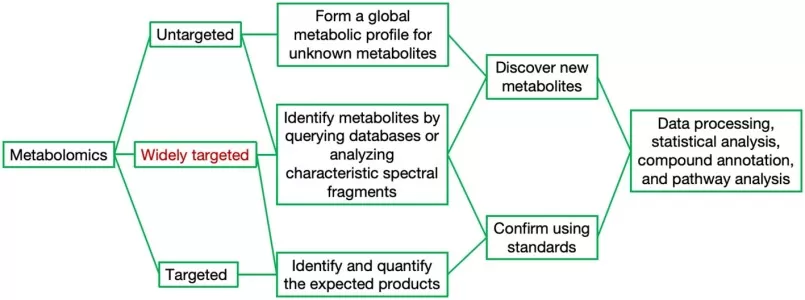
Figure 2. Targeted, widely targeted, and untargeted metabolomics approaches. Reproduced from Figure 2 in Ji et al. (2024), Frontiers in Plant Science, under CC BY 4.0; resized for layout with no content changes.
Table 2. Untargeted, Targeted, and Widely Targeted Metabolomics: Key Differences
| Dimension | Untargeted | Targeted | Widely Targeted |
|---|---|---|---|
| Primary goal | Broad discovery and hypothesis generation | Defined measurement, confirmation, and validation | Broad, reproducible measurement of a library-guided panel |
| Prior target list | No narrow predefined list | Defined before analysis | Broad database-, library-, or method-informed list |
| Typical output | Features plus metabolites at different annotation levels | Predefined metabolites | Large monitored panel of known or library-supported metabolites |
| Quantification | Mainly relative or semiquantitative | Relative or validated absolute | Mainly relative or semiquantitative |
| Best suited for | Exploratory studies | Validation and precise quantification | Large comparative studies requiring breadth and consistency |
| Main limitation | Annotation and reproducibility challenges | Restricted coverage and method-development burden | Library and method dependence; terminology varies |
4.1 Untargeted Metabolomics: Broad Discovery
Untargeted metabolomics does not restrict data acquisition to a small predefined list of compounds. Its goal is to obtain broad metabolic feature coverage within the limits of a selected platform and workflow. It is particularly useful for hypothesis generation, discovery of unexpected changes, candidate biomarker screening, and characterization of system-wide metabolic perturbations.
The typical output includes detected features defined by properties such as mass-to-charge ratio, retention time, and signal intensity, together with metabolites assigned at different annotation confidence levels. Data processing commonly requires peak detection, alignment, quality filtering, statistical analysis, and metabolite annotation. Many signals remain incompletely identified, and the results are usually relative or semiquantitative rather than validated absolute concentrations. Major challenges include incomplete annotation, matrix effects, wide concentration ranges, missing values, batch variation, and the interpretation of unknown features (Alseekh et al., 2021).
4.2 Targeted Metabolomics: Defined Analytes and Quantification
Targeted metabolomics defines the analytes, metabolite class, or pathway before data acquisition. Extraction, chromatography, ion transitions, and other analytical parameters are then optimized for the selected compounds. This strategy is well suited to candidate confirmation, pathway-focused studies, pharmacodynamic assessment, and projects requiring high selectivity or quantitative reliability.
Targeted analysis does not automatically mean absolute quantification. Absolute concentration measurements require analyte-specific standards, suitable calibration models, appropriate internal standards, and a method validated for the sample matrix and intended use. When these elements are present, targeted assays can provide high sensitivity, selectivity, and quantitative confidence. The principal trade-off is restricted coverage: compounds outside the predefined panel will not be measured, and assay development can require substantial time and resources (Alseekh et al., 2021).
4.3 Widely Targeted Metabolomics: Broad, Reproducible Measurement
Widely targeted metabolomics generally refers to the controlled measurement of a large, library-informed set of metabolites. In many implementations, high-resolution data, authentic standards, spectral libraries, databases, or previous experiments are used to establish a broad target library. A triple-quadrupole or related platform can then monitor selected precursor-product ion transitions, often through multiple reaction monitoring. An early influential widely targeted strategy demonstrated how an MS/MS spectral tag library could support large-scale metabolite detection and measurement in rice (Chen et al., 2013).
This approach is useful when a study needs broader known-metabolite coverage than a conventional targeted panel while also prioritizing reproducibility across many samples. Its outputs are commonly relative or semiquantitative measurements of predefined or library-supported metabolites; analyte-specific absolute quantification requires additional calibration and validation. Widely targeted metabolomics is also bounded by its library and acquisition method: compounds outside the target list or unsupported by the library are not automatically discovered. Because the terminology is not fully standardized, reports should describe how targets were selected, how compounds were identified, which acquisition mode was used, and what type of quantification was achieved.
4.4 Selecting and Combining Metabolomics Strategies
Method choice follows from the question and the required endpoint. Studies that need to look beyond a predefined list generally begin with untargeted analysis, whereas matrix-validated concentrations require targeted methods, suitable standards, and calibration. Sample amount, metabolite stability, cohort size, batch duration, and available reference materials may narrow the options. LC-MS, GC-MS, and NMR can also be combined when one platform does not provide sufficient chemical coverage (Alseekh et al., 2021).
Many projects are better designed as a sequence than as a single assay. Untargeted analysis can nominate candidate features; MS/MS, retention time, authentic standards, and other orthogonal data can then strengthen identification; and priority metabolites can move into targeted assays for independent validation. Widely targeted metabolomics is useful when the next step requires consistent measurement of a broad set of known metabolites. Mechanistic questions may then add isotope tracing, enzyme activity, genetic perturbation, or other functional experiments.
5. How to Interpret Metabolomics Results: From Analytical Signals to Biological Evidence
A metabolomics result is only as strong as the evidence linking the analytical signal to a molecular identity, a quantitative value, and a biological interpretation. Each step should be reported at the level the data actually support.
5.1 From Detected Features to Confirmed Metabolites
In LC-MS data, a detected feature is typically defined by mass-to-charge ratio, retention time, and signal intensity. It is not automatically a confirmed molecular structure. Accurate mass matching, isotope patterns, MS/MS similarity, and retention behavior provide different levels of annotation evidence; comparison with an authentic standard under matched analytical conditions provides stronger confirmation. The Metabolomics Standards Initiative established minimum reporting principles for chemical analysis and metabolite identification (Sumner et al., 2007). Clear reporting should therefore distinguish detected features, annotated compounds, putatively identified metabolites, and metabolites confirmed against authentic standards.
5.2 Relative Abundance, Absolute Concentration, and Metabolic Flux
Peak area, peak height, or a normalized signal usually represents relative abundance. It should not be described as an absolute concentration unless the assay includes the calibration and validation required for concentration measurement. Even a reliable concentration describes the size of a metabolite pool at a particular time. Pool size reflects the combined effects of production, consumption, transport, compartmentalization, exchange, and clearance.
Metabolic flux describes the rate at which material moves through a pathway. A metabolite can remain at a similar concentration even when its production and consumption rates both increase, or it can accumulate because consumption slows rather than because synthesis accelerates. Stable-isotope tracing adds dynamic information by following labeled atoms through metabolic reactions, but tracer choice, time course, compartmentation, and model assumptions still determine which flux-oriented conclusions are justified (Jang et al., 2018).
5.3 Association, Pathway Enrichment, and Biomarker Validation
Differential metabolites, correlations, and pathway enrichment can identify patterns compatible with a biological hypothesis. They do not, by themselves, prove that a pathway is activated, that one metabolite causes a phenotype, or that a candidate is clinically useful. Diet, medication, sample composition, disease stage, batch, storage, and other confounders may contribute to observed associations. Pathway results are also affected by metabolite identification confidence, database coverage, pathway size, and the statistical method used.
A candidate biomarker requires more than a significant group difference. It should be measured using a fit-for-purpose analytical method, evaluated against relevant confounders and comparators, and validated in independent samples for a clearly defined intended use (Castelli et al., 2022). Reliable interpretation combines experimental design, analytical quality control, metabolite identification, appropriate statistical models, and complementary functional evidence.
Reliable metabolomics depends on matching the analytical strategy to the question and reporting each result at the level supported by the evidence. Clear terminology, transparent quantitative claims, and explicit validation steps make the biological interpretation easier to test and reproduce.
6. Metabolomics FAQs
6.1 Does Untargeted Metabolomics Measure the Entire Metabolome?
No. Untargeted metabolomics aims for broad feature coverage within a defined platform and workflow, but extraction chemistry, chromatography, ionization, detector sensitivity, and data processing all limit what is observed. The output may also contain features whose molecular identities remain uncertain.
6.2 Does Targeted Metabolomics Always Provide Absolute Concentrations?
No. Targeted acquisition improves selectivity for predefined analytes, but absolute quantification requires authentic standards, suitable calibration curves, appropriate internal standards, and validation in the relevant sample matrix. Without these elements, targeted results may still be relative or semiquantitative.
6.3 Can Differential Metabolites or Pathway Enrichment Prove a Mechanism?
Not by themselves. Differential signals and pathway enrichment can support a biological hypothesis, but they do not establish pathway flux, causality, or biomarker validity. Stronger claims usually require confident metabolite identification, control of relevant confounders, independent validation, and functional evidence such as isotope tracing, enzyme assays, or genetic perturbation.
How MetwareBio Supports Metabolomics Study Design
MetwareBio supports untargeted metabolomics, targeted metabolomics, TM Widely-Targeted Metabolomics, and the Plant Widely-Targeted Metabolomics Service, together with study consultation, sample-preparation planning, analytical quality control, statistical analysis, pathway interpretation, and multi-omics integration. Projects can progress from broad discovery and metabolite confirmation to targeted validation, with transcriptomics, proteomics, or microbiome data added when the biological question requires broader context.
Planning a metabolomics study? Contact MetwareBio to discuss sample type, analytical coverage, quantification, and validation strategy.
Contact UsRead More: Metabolomics Strategies and Data Analysis
These articles expand on the metabolomics frameworks introduced here, covering practical workflow design, analytical strategy comparisons, and data processing methods for both discovery and validation studies.
A focused comparison of the three main metabolomics strategies discussed in Section 4. This article provides practical guidance on when to choose each approach based on study goals, sample types, and quantitative requirements.
Dive deeper into the untargeted metabolomics workflow introduced here. This article covers peak detection, alignment, annotation, and statistical analysis steps that transform raw LC-MS data into biological insights.
An expanded overview of metabolomics as a field, covering historical development, technology platforms, and applications across biomedical, plant, and microbial research beyond the fundamentals covered in this introduction.
A concise companion piece that reinforces the core concepts of metabolomics, the metabolome, and analytical platforms. Useful as a quick reference for researchers new to the field.
Before biological interpretation, metabolomics data requires careful preprocessing. This article covers normalization, batch correction, missing value treatment, and quality control steps that directly affect downstream results.
Once metabolomics data is processed, multivariate statistical methods help identify patterns and group separations. This guide compares three common dimensionality reduction approaches and their appropriate use cases.
References
- Alseekh, S., Aharoni, A., Brotman, Y., Contrepois, K., D'Auria, J., Ewald, J., Ewald, J. C., Fraser, P. D., Giavalisco, P., Hall, R. D., Heinemann, M., Link, H., Luo, J., Neumann, S., Nielsen, J., Perez de Souza, L., Saito, K., Sauer, U., Schroeder, F. C., ... Fernie, A. R. (2021). Mass spectrometry-based metabolomics: A guide for annotation, quantification and best reporting practices. Nature Methods, 18(7), 747-756. https://doi.org/10.1038/s41592-021-01197-1
- Castelli, F. A., Rosati, G., Moguet, C., Fuentes, C., Marrugo-Ramirez, J., Lefebvre, T., Volland, H., Merkoci, A., Simon, S., Fenaille, F., & Junot, C. (2022). Metabolomics for personalized medicine: The input of analytical chemistry from biomarker discovery to point-of-care tests. Analytical and Bioanalytical Chemistry, 414, 759-789. https://doi.org/10.1007/s00216-021-03586-z
- Chen, W., Gong, L., Guo, Z., Wang, W., Zhang, H., Liu, X., Yu, S., Xiong, L., & Luo, J. (2013). A novel integrated method for large-scale detection, identification, and quantification of widely targeted metabolites: Application in the study of rice metabolomics. Molecular Plant, 6(6), 1769-1780. https://doi.org/10.1093/mp/sst080
- Fiehn, O. (2002). Metabolomics: The link between genotypes and phenotypes. Plant Molecular Biology, 48(1-2), 155-171. https://doi.org/10.1023/A:1013713905833
- Jang, C., Chen, L., & Rabinowitz, J. D. (2018). Metabolomics and isotope tracing. Cell, 173(4), 822-837. https://doi.org/10.1016/j.cell.2018.03.055
- Ji, P., Yang, X., & Zhao, X. (2024). Application of metabolomics in quality control of traditional Chinese medicines: A review. Frontiers in Plant Science, 15, 1463666. https://doi.org/10.3389/fpls.2024.1463666
- Letertre, M. P. M., Giraudeau, P., & de Tullio, P. (2021). Nuclear magnetic resonance spectroscopy in clinical metabolomics and personalized medicine: Current challenges and perspectives. Frontiers in Molecular Biosciences, 8, 698337. https://doi.org/10.3389/fmolb.2021.698337
- Liu, Z., Zhang, M., Chen, P., Harnly, J. M., & Sun, J. (2022). Mass spectrometry-based nontargeted and targeted analytical approaches in fingerprinting and metabolomics of food and agricultural research. Journal of Agricultural and Food Chemistry, 70(36), 11138-11153. https://doi.org/10.1021/acs.jafc.2c01878
- Sumner, L. W., Amberg, A., Barrett, D., Beale, M. H., Beger, R., Daykin, C. A., Fan, T. W.-M., Fiehn, O., Goodacre, R., Griffin, J. L., Hankemeier, T., Hardy, N., Harnly, J., Higashi, R., Kopka, J., Lane, A. N., Lindon, J. C., Marriott, P., Nicholls, A. W., ... Viant, M. R. (2007). Proposed minimum reporting standards for chemical analysis: Chemical Analysis Working Group (CAWG) Metabolomics Standards Initiative (MSI). Metabolomics, 3(3), 211-221. https://doi.org/10.1007/s11306-007-0082-2
- Villas-Boas, S. G., Mas, S., Akesson, M., Smedsgaard, J., & Nielsen, J. (2005). Mass spectrometry in metabolome analysis. Mass Spectrometry Reviews, 24(5), 613-646. https://doi.org/10.1002/mas.20032