β-Hydroxybutyrate (BHB) is one of the major ketone bodies produced during fasting, prolonged exercise, carbohydrate restriction, and other conditions that shift energy metabolism toward greater reliance on fatty acids. Long regarded primarily as an alternative fuel, BHB is now recognized as an important metabolic molecule involved in cellular signaling, inflammatory regulation, gene expression, and tissue function. Growing evidence linking BHB to metabolic adaptation and a range of physiological and disease processes has expanded interest in its biological roles and research applications. Understanding how BHB is produced, utilized, regulated, and measured is therefore important for studying both normal metabolism and disease-associated metabolic changes. This article provides an evidence-based overview of BHB metabolism, molecular functions, physiological and disease relevance, and current approaches for its measurement in metabolomics research.
What Is β-Hydroxybutyrate (BHB)?
β-Hydroxybutyrate, also called β-hydroxybutyric acid or 3-hydroxybutyrate and abbreviated BHB, β-HB, or βOHB, is a four-carbon hydroxy acid. It lacks the carbonyl group that chemically defines a ketone, yet physiologically it is grouped with acetoacetate (AcAc) and acetone as a ketone body because all three arise from the same hepatic pathway. BHB and AcAc are the principal circulating, metabolically active ketone bodies; acetone forms largely through spontaneous decarboxylation of AcAc and is mainly eliminated through breath and urine (Puchalska and Crawford, 2021).
BHB is chiral and exists as D- and L-enantiomers, also designated R- and S-BHB. Mammalian hepatic ketogenesis produces predominantly D-BHB because mitochondrial β-hydroxybutyrate dehydrogenase 1 (BDH1) stereoselectively interconverts AcAc and D-BHB. D-BHB is therefore the principal endogenous form entering classical ketone oxidation. L-BHB follows different metabolic routes and persists longer in human circulation after ingestion of racemic ketone salts (Stubbs et al., 2017).
BHB Metabolism: Ketogenesis and Ketolysis
Ketogenesis: BHB Production in the Liver
Ketogenesis occurs primarily in hepatic mitochondria during metabolic states that favor fatty acid mobilization and oxidation. During fasting or marked carbohydrate restriction, lower insulin signaling and increased counter-regulatory activity stimulate adipose lipolysis, supplying non-esterified fatty acids to the liver. β-Oxidation generates acetyl-CoA and reducing equivalents, while hepatic carbon is also directed toward gluconeogenesis. The resulting substrate and redox environment favors conversion of excess acetyl-CoA into ketone bodies (Ruppert and Kersten, 2024).
Two acetyl-CoA molecules first form acetoacetyl-CoA through ACAT1. Mitochondrial HMG-CoA synthase 2 (HMGCS2), a central regulatory enzyme of ketogenesis, produces HMG-CoA, and HMG-CoA lyase (HMGCL) then forms AcAc. BDH1 reversibly reduces AcAc to D-BHB using NADH. Because this reaction is redox coupled, the BHB:AcAc balance contains information about hepatic mitochondrial redox state, although circulating ratios are also shaped by transport and peripheral utilization and cannot be treated as a universal tissue redox readout (Puchalska and Crawford, 2021).
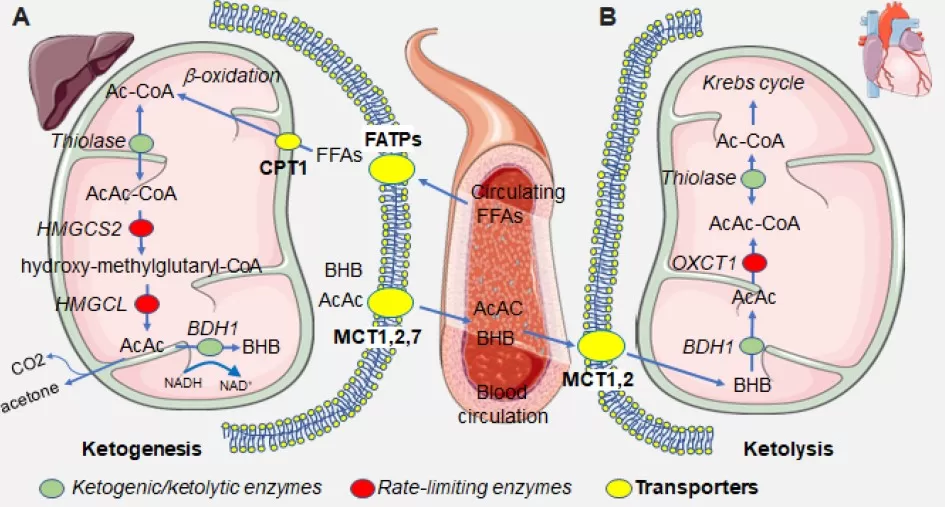
Summarizing scheme of the metabolism of ketone bodies in the hepatic and extrahepatic compartments. Source: Bendridi N, et al. Int J Mol Sci. 2022;23(23):14564, licensed under CC BY 4.0.
Ketolysis: BHB Utilization in Extrahepatic Tissues
Circulating BHB enters extrahepatic cells through monocarboxylate transporters and is oxidized by mitochondrial BDH1 back to AcAc. Succinyl-CoA:3-oxoacid CoA transferase (SCOT), encoded by OXCT1, transfers CoA to AcAc to form acetoacetyl-CoA; ACAT1 then yields two acetyl-CoA molecules for the tricarboxylic acid (TCA) cycle and oxidative phosphorylation. Hepatocytes have very low SCOT/OXCT1 activity, creating a useful division of labor: the liver exports ketone bodies while peripheral organs oxidize them. During prolonged fasting, the brain becomes a major ketone consumer, while heart, skeletal muscle, and kidney can also use BHB efficiently (Newman and Verdin, 2017; Puchalska and Crawford, 2021).
BHB Signaling and Epigenetic Regulation
BHB Receptor Signaling
BHB can alter cellular responses independently of its oxidation for ATP. One well-characterized target is hydroxycarboxylic acid receptor 2 (HCAR2/GPR109A), a Gi/o-coupled receptor expressed in adipocytes and several immune-cell populations. D-BHB activates HCAR2 and suppresses adipocyte lipolysis, creating a feedback connection between rising ketone availability and fatty acid release from adipose tissue (Taggart et al., 2005). HCAR2-dependent effects have also been demonstrated in experimental immune and neurological models, although their contribution varies by tissue and condition.
BHB has additionally been reported to antagonize free fatty acid receptor 3 (FFAR3/GPR41) in sympathetic ganglia, linking ketone availability to sympathetic activity in mice (Kimura et al., 2011). The physiological importance of this pathway in humans remains less clearly defined. Together, these receptor-level effects show that a change in BHB concentration can carry signaling information before its carbon is incorporated into central energy metabolism.
BHB Regulation of the NLRP3 Inflammasome
The NLRP3 inflammasome is an innate immune signaling complex that responds to a range of cellular stress and danger signals. Upon activation, NLRP3 promotes assembly of the adaptor protein ASC and activation of caspase-1, which subsequently processes pro-IL-1β and pro-IL-18 into their mature inflammatory forms. BHB has been shown to directly influence this pathway, providing a mechanistic link between ketone metabolism and innate immune regulation.
In a key study, Youm and colleagues found that BHB suppressed NLRP3 inflammasome activation triggered by ATP, urate crystals, and lipotoxic fatty acids in human monocytes and mouse macrophages (Youm et al., 2015). Mechanistically, BHB prevented potassium (K⁺) efflux, an important upstream event in NLRP3 activation, and reduced ASC oligomerization and speck formation. These effects limited subsequent caspase-1 activation and the production of mature IL-1β and IL-18. The inhibition occurred independently of BHB oxidation and HCAR2 signaling, indicating that it represents a signaling action distinct from the use of BHB as an energy substrate. BHB also showed selectivity for NLRP3 in this study, with little effect on NLRC4 or AIM2 inflammasome activation. Consistent with the cellular findings, BHB administration or a ketogenic diet reduced NLRP3-associated inflammatory responses in several mouse models. Together, these findings support BHB as a metabolic regulator of the NLRP3 inflammasome, although the magnitude and physiological relevance of this effect may vary across tissues and disease settings.
BHB in HDAC Regulation and β-Hydroxybutyrylation
BHB can influence gene regulation through chromatin-associated mechanisms. One proposed pathway involves histone deacetylases (HDACs). Shimazu and colleagues reported that D-BHB inhibited class I HDACs, increased histone acetylation, and enhanced expression of oxidative-stress-response genes such as Foxo3a and Mt2 (Shimazu et al., 2013). These findings linked elevated BHB during fasting-related metabolic states with transcriptional regulation, although the strength of direct HDAC inhibition appears to vary across experimental systems (Chriett et al., 2019).
BHB is also associated with lysine β-hydroxybutyrylation (Kbhb), a distinct post-translational modification in which a β-hydroxybutyryl group is added to lysine residues. Xie and colleagues showed that histone Kbhb increased during prolonged fasting and experimental ketoacidosis, and that H3K9 β-hydroxybutyrylation was associated with actively expressed genes (Xie et al., 2016). Kbhb has since been detected on both histone and non-histone proteins, suggesting an additional route through which ketone metabolism may influence cellular regulation.
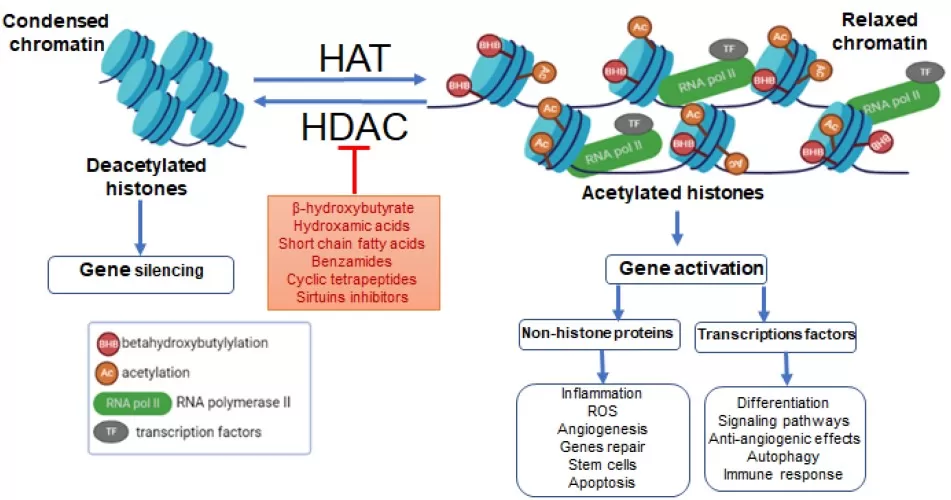
Effects of HAT and HDAC on β-hydroxybutyrylation, the chromatin’s transcriptional dynamics, and consequences of epigenetic remodeling on pathologies. Source: Bendridi N, et al. Int J Mol Sci. 2022;23(23):14564, licensed under CC BY 4.0.
β-Hydroxybutyrate and Health: Physiological Roles and Disease Relevance
BHB in Metabolic Adaptation and Normal Physiology
Physiological ketosis is an adaptive response that helps maintain energy supply when glucose availability decreases or energy demand changes. During fasting, prolonged exercise, carbohydrate restriction, and the neonatal period, hepatic ketogenesis increases and BHB carries fatty-acid-derived energy from the liver to extrahepatic tissues. This alternative fuel becomes particularly important during prolonged fasting, when the brain increases ketone oxidation and reduces its reliance on glucose, helping preserve glucose for tissues with greater dependence on it.
Circulating BHB can also be raised through exogenous ketone esters or salts. This produces ketosis without the full hormonal and metabolic changes that accompany fasting or carbohydrate restriction, such as increased adipose lipolysis and sustained fatty acid delivery to the liver. Racemic ketone salts may additionally provide both D- and L-BHB, which differ in metabolic handling (Stubbs et al., 2017). Exogenous ketones therefore provide a useful way to study the physiological effects of elevated BHB separately from the broader metabolic adaptations of endogenous ketosis.
BHB in Metabolic and Cardiovascular Disease
BHB changes substantially in several metabolic and cardiovascular conditions, but the underlying biology differs among diseases. Diabetic ketoacidosis (DKA) represents the clearest example of pathological ketone accumulation. Severe insulin deficiency increases adipose lipolysis and hepatic fatty acid oxidation, driving excessive ketone-body production and a marked rise in circulating BHB. As BHB and acetoacetate accumulate, metabolic acidosis develops, making blood BHB an important biochemical marker for the diagnosis and monitoring of DKA (Umpierrez et al., 2024). This setting is fundamentally different from the controlled rise in ketones seen during fasting or nutritional ketosis.
In heart failure, increased ketone metabolism appears to serve a more adaptive role. The failing heart undergoes extensive remodeling of substrate utilization and shows increased uptake and oxidation of ketone bodies, including BHB. Ketone oxidation can contribute additional acetyl-CoA for ATP production when cardiac energy metabolism is impaired, and both circulating ketone availability and myocardial ketolytic pathways are altered in heart failure (Lopaschuk and Dyck, 2023). These observations have made BHB an active area of research in cardiac energy metabolism and have stimulated studies of whether modifying ketone availability can influence cardiac function.
BHB in Neurological, Inflammatory, and Aging Research
BHB has attracted particular interest in neurological research because the brain can substantially increase ketone utilization when circulating glucose availability is limited. Ketogenic diets are an established therapy for selected forms of drug-resistant epilepsy (Bendridi et al., 2022), and BHB is thought to contribute through a combination of energy provision and signaling effects. Research in neurodegeneration and brain injury has further explored how BHB may influence mitochondrial metabolism, oxidative stress, neuronal excitability, and inflammatory signaling, although the contribution of each mechanism differs among experimental models.
Interest in BHB has also expanded into inflammation and aging biology. Its ability to regulate HCAR2 signaling, inhibit NLRP3 inflammasome activation, alter redox metabolism, and participate in lysine β-hydroxybutyrylation provides several molecular routes through which changes in ketone metabolism could influence immune and stress-response programs (Puchalska and Crawford, 2021; Madhavan and Stubbs, 2025). Studies of fasting, ketogenic diets, and exogenous ketones have consequently positioned BHB as an important candidate mediator linking metabolic state with inflammatory control, cellular stress responses, and age-associated physiological changes.
Beta-Hydroxybutyrate Measurement: Samples and Analytical Methods
Biological Samples and Preanalytical Variables
BHB can be measured in whole blood, plasma or serum, urine, tissues, cultured cells, and other biological matrices, but the matrix determines what biological question the measurement can address. Circulating BHB reflects systemic ketone availability, whereas tissue or cellular measurements provide information on local BHB abundance and exposure, which may differ from blood concentrations. Because BHB responds rapidly to fasting duration, recent diet, exercise, insulin status, sampling time, and exogenous ketone intake, these variables should be standardized or recorded when comparing groups. Measurements of BHB uptake or oxidation require kinetic approaches, such as stable-isotope tracing, rather than concentration data alone.
Sample handling becomes particularly important when BHB is analyzed together with acetoacetate (AcAc). BHB is relatively stable, while AcAc can spontaneously decarboxylate to acetone during storage. Delayed processing or inappropriate storage can therefore alter the measured BHB/AcAc relationship, making rapid processing and controlled low-temperature storage important for ketone-body profiling (Puchalska et al., 2021).
Analytical Methods for BHB Measurement
BHB can be measured using methods ranging from rapid enzymatic assays to mass spectrometry- and NMR-based metabolomic analysis, with the appropriate approach depending on the research objective.
- Enzymatic assays based on β-hydroxybutyrate dehydrogenase are widely used for routine blood BHB assessment because they provide rapid, direct measurement and are well suited to monitoring ketosis.
- For research applications, mass spectrometry supports both targeted quantification and untargeted metabolic profiling. Targeted LC-MS/MS can quantify BHB with analyte-specific calibration and stable-isotope internal standards and can simultaneously measure related metabolites such as acetoacetate, providing a more detailed view of ketone metabolism (Puchalska et al., 2021; Afshar and van Hall, 2023). GC-MS can also provide quantitative BHB measurement, although derivatization is generally required before analysis. When D- and L-BHB need to be resolved separately, an additional stereoselective separation or derivatization strategy is required. Untargeted metabolomics addresses a different research question. LC-MS- or GC-MS-based untargeted workflows measure BHB together with hundreds to thousands of other metabolic features, allowing changes in BHB to be interpreted within broader alterations in fatty acid oxidation, energy metabolism, and related pathways.
- NMR spectroscopy can likewise measure BHB within metabolic profiles and offers high structural reproducibility, although its sensitivity is generally lower than that of targeted MS methods.
Comparison of Analytical Methods for BHB Measurement
| Analytical Approach | Common Techniques | What It Provides | Best Suited For | Key Considerations |
|---|---|---|---|---|
| Rapid BHB measurement | Enzymatic assays, blood ketone meters | Direct measurement of circulating BHB, commonly D-BHB | Routine assessment of ketosis and clinical monitoring | Fast and convenient, but provides little information about broader ketone or metabolic pathways; stereospecificity depends on assay design |
| Targeted quantitative analysis | LC-MS/MS, GC-MS, quantitative NMR | Quantitative measurement of BHB, often together with AcAc or selected related metabolites | Hypothesis-driven studies, precise BHB quantification, and comparison of defined metabolic endpoints | Absolute quantification requires validated calibration and appropriate internal standards; GC-MS generally requires derivatization; D/L-BHB differentiation requires a stereoselective strategy |
| Untargeted metabolomic profiling | LC-MS, GC-MS, NMR | BHB measured within a broad metabolic profile together with many other metabolites or metabolic features | Discovery studies and investigation of BHB within wider changes in energy, lipid, and intermediary metabolism | Usually provides relative or semi-quantitative BHB information unless additional quantitative validation is performed; conventional workflows generally do not distinguish D- and L-BHB |
Frequently Asked Questions About β-Hydroxybutyrate
Is Beta-Hydroxybutyrate Really a Ketone Body?
Yes in physiological terminology. BHB is chemically a hydroxy acid, but it is classified as a ketone body because it is produced from AcAc within hepatic ketogenesis and participates in the same inter-organ fuel system.
What Is the Difference Between BHB and Acetoacetate?
AcAc is generated directly during ketogenesis and can be reversibly reduced to D-BHB by BDH1. Their interconversion is redox coupled, so measuring both can provide information that a BHB-only measurement cannot capture.
What Is the Difference Between D-BHB and L-BHB?
D-BHB is the principal endogenous enantiomer produced during hepatic ketogenesis and enters classical ketone oxidation. L-BHB is metabolized differently and persists longer after racemic ketone-salt ingestion, making assay stereospecificity important in exogenous-ketone studies.
Does a High BHB Concentration Always Mean Ketoacidosis?
No. BHB also rises during fasting, prolonged exercise, ketogenic diets, and after exogenous ketone intake. DKA is defined by a broader clinical and biochemical context that includes ketonemia and metabolic acidosis (Umpierrez et al., 2024).
Can Untargeted Metabolomics Provide an Absolute BHB Concentration?
Usually not without additional compound-specific validation. Untargeted workflows generally report relative or semi-quantitative BHB changes; absolute concentration requires validated calibration, appropriate standards, internal-standard correction, and quality control.
Measure β-Hydroxybutyrate with MetwareBio Metabolomics Services
BHB is an important indicator of ketone metabolism and a biologically active metabolite involved in energy adaptation, cellular signaling, inflammation, and metabolic disease. Reliable measurement of BHB can therefore provide valuable information for studies of metabolic regulation and related physiological or pathological processes.
MetwareBio offers both targeted and untargeted metabolomics approaches for BHB analysis. Our Organic Acid Targeted Metabolomics service includes 3-D-hydroxybutyric acid and supports focused quantitative analysis when BHB is a defined study endpoint. Untargeted Metabolomics can detect BHB together with a broad range of other metabolites, enabling researchers to explore its changes within wider metabolic responses and identify associated pathways or metabolite patterns. Researchers can select the approach that best matches their study objective or combine targeted quantification with broader metabolomic profiling for complementary information.
Contact UsRead More: Ketone Bodies, Targeted Metabolomics, and Omics Statistics
These articles complement the current BHB guide by detailing organic-acid and energy-metabolism quantification, broader targeted and untargeted metabolomics strategies, multi-omics integration, and the statistical criteria used to screen and interpret differential metabolite features.
MetwareBio’s organic-acid targeted panel quantifies 65 analytes across the TCA cycle, fatty-acid oxidation, amino-acid-derived acids, and phenolic/indolic acids. BHB is included as 3-D-hydroxybutyric acid, supporting absolute quantification when ketone metabolism is a defined study endpoint.
This service profiles central-carbon metabolites with compound-specific calibration curves and MRM detection, fitting studies that examine how circulating BHB, AcAc, and related TCA intermediates change with fasting, ketogenic diets, or disease-associated metabolic shifts.
A focused overview of MetwareBio’s targeted metabolomics portfolio, which delivers absolute quantification for energy metabolism, amino acids, organic acids, bile acids, hormones, and other defined compound panels using chemical standards and LC-MS/MS.
Describes global metabolome profiling by high-resolution LC-MS/MS and is a useful complement to the targeted panel: BHB can be measured together with hundreds to thousands of additional features for biomarker discovery and pathway-level interpretation.
Explains how transcriptomics, proteomics, metabolomics, and microbiomics can be integrated through name-, function-, correlation-, and biomarker-based strategies, helping connect BHB changes to upstream transcriptional or proteomic signals in the same cohort.
A practical guide to the four most common statistical filters used to identify biologically meaningful BHB and related metabolite changes, with case studies in metabolomics, proteomics, and spatial omics.
References
- Bendridi N, Selmi A, Balcerczyk A, Pirola L. Ketone Bodies as Metabolites and Signalling Molecules at the Crossroad between Inflammation and Epigenetic Control of Cardiometabolic Disorders. Int J Mol Sci. 2022;23(23):14564. doi:10.3390/ijms232314564.
- Madhavan SS, Stubbs BJ. Beta-hydroxybutyrate. Trends Endocrinol Metab. 2025;36(1):96-97. doi:10.1016/j.tem.2024.06.005.
- Ruppert PMM, Kersten S. Mechanisms of hepatic fatty acid oxidation and ketogenesis during fasting. Trends Endocrinol Metab. 2024;35(2):107-124. doi:10.1016/j.tem.2023.10.002.
- Puchalska P, Crawford PA. Metabolic and Signaling Roles of Ketone Bodies in Health and Disease. Annu Rev Nutr. 2021;41:49-77. doi:10.1146/annurev-nutr-111120-111518.
- Newman JC, Verdin E. β-Hydroxybutyrate: A Signaling Metabolite. Annu Rev Nutr. 2017;37:51-76. doi:10.1146/annurev-nutr-071816-064916.
- Stubbs BJ, Cox PJ, Evans RD, et al. On the Metabolism of Exogenous Ketones in Humans. Front Physiol. 2017;8:848. doi:10.3389/fphys.2017.00848.
- Taggart AKP, Kero J, Gan X, et al. (D)-β-Hydroxybutyrate inhibits adipocyte lipolysis via the nicotinic acid receptor PUMA-G. J Biol Chem. 2005;280(29):26649-26652. doi:10.1074/jbc.C500213200.
- Kimura I, Inoue D, Maeda T, et al. Short-chain fatty acids and ketones directly regulate sympathetic nervous system via G protein-coupled receptor 41 (GPR41). Proc Natl Acad Sci U S A. 2011;108(19):8030-8035. doi:10.1073/pnas.1016088108.
- Youm YH, Nguyen KY, Grant RW, et al. The ketone metabolite β-hydroxybutyrate blocks NLRP3 inflammasome-mediated inflammatory disease. Nat Med. 2015;21(3):263-269. doi:10.1038/nm.3804.
- Shimazu T, Hirschey MD, Newman J, et al. Suppression of oxidative stress by β-hydroxybutyrate, an endogenous histone deacetylase inhibitor. Science. 2013;339(6116):211-214. doi:10.1126/science.1227166.
- Chriett S, Dąbek A, Wojtala M, et al. Prominent action of butyrate over β-hydroxybutyrate as histone deacetylase inhibitor, transcriptional modulator and anti-inflammatory molecule. Sci Rep. 2019;9:742. doi:10.1038/s41598-018-36941-9.
- Xie Z, Zhang D, Chung D, et al. Metabolic Regulation of Gene Expression by Histone Lysine β-Hydroxybutyrylation. Mol Cell. 2016;62(2):194-206. doi:10.1016/j.molcel.2016.03.036.
- Lopaschuk GD, Dyck JRB. Ketones and the cardiovascular system. Nat Cardiovasc Res. 2023;2:425-437. doi:10.1038/s44161-023-00259-1.
- Umpierrez GE, Davis GM, ElSayed NA, et al. Hyperglycemic Crises in Adults With Diabetes: A Consensus Report. Diabetes Care. 2024;47(8):1257-1275. doi:10.2337/dci24-0032.
- Puchalska P, Nelson AB, Stagg DB, Crawford PA. Determination of ketone bodies in biological samples via rapid UPLC-MS/MS. Talanta. 2021;225:122048. doi:10.1016/j.talanta.2020.122048.
- Afshar M, van Hall G. LC-MS/MS method for quantitative profiling of ketone bodies, α-keto acids, lactate, pyruvate and their stable isotopically labelled tracers in human plasma: An analytical panel for clinical metabolic kinetics and interactions. J Chromatogr B Analyt Technol Biomed Life Sci. 2023;1230:123906. doi:10.1016/j.jchromb.2023.123906.