Summer can slow down research timelines, but it can also be the right moment to move sample testing, pilot studies, and biomarker discovery projects forward. From July 13 to August 31, 2026, MetwareBio is offering 15% OFF DIA Quantitative Proteomics and Blood Quantitative Proteomics to help researchers generate deeper, more reproducible proteome data for disease mechanism studies, biomarker discovery, drug response research, and multi-omics interpretation.
1. SUMMER PROTEOMICS LAUNCHPAD: A LIMITED-TIME 15% OFF PROMOTION
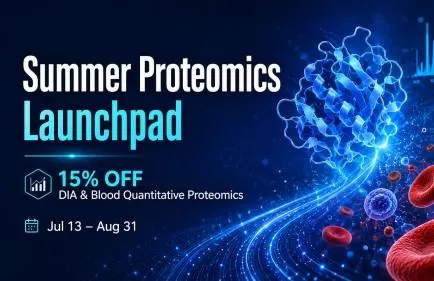 MetwareBio's Summer Proteomics Launchpad is designed for researchers who want to begin or advance a proteomics project before the fall research season. Whether you are preparing preliminary data, validating a disease mechanism, profiling treatment response, or exploring serum and plasma biomarkers, this promotion helps lower the cost of starting a high-quality proteomics study.
Promotion period: July 13 - August 31, 2026
Discount: 15% OFF
Participating services:
This offer is especially useful for researchers who have collected valuable tissue, cell, serum, or plasma samples but are still deciding how to turn them into actionable biological insight.
Planning a Large-Cohort DIA Proteomics Study?
For researchers planning larger DIA proteomics projects, MetwareBio is also offering special large-cohort pricing: $399/sample for 100+ DIA samples and $299/sample for 300+ DIA samples. This offer is available through September 30, 2026 and is designed for cohort-scale discovery proteomics projects requiring reproducible data generation and structured quality control.
2. WHY DIA PROTEOMICS IS A STRONG CHOICE FOR DISCOVERY RESEARCH
Data-independent acquisition, or DIA, is a mass spectrometry acquisition strategy that fragments ions across defined m/z windows rather than selecting only a limited number of precursor ions. This acquisition strategy supports more consistent peptide and protein quantification across replicates, time points, treatment groups, and larger sample cohorts (Gillet et al., 2012, Molecular & Cellular Proteomics).
For biomedical and life science research, DIA proteomics is particularly valuable when the goal is to compare protein abundance across groups and identify biological pathways affected by disease, treatment, genetic perturbation, or environmental stress. Compared with more stochastic precursor selection strategies, DIA is widely used when reproducibility and data completeness are important for quantitative proteomics studies (Gillet et al., 2012, Molecular & Cellular Proteomics).
MetwareBio's DIA Quantitative Proteomics service is powered by a 4D LC-MS/MS workflow using Bruker timsTOF HT and diaPASEF® acquisition, enabling high-resolution ion mobility separation and deep proteome profiling (Meier et al., 2020, Nature Methods). With optimized DIA workflows, the platform can quantify over 12,000 proteins, depending on sample type and database quality.
2.1 DIA Proteomics Is Well Suited For
- Disease mechanism studies
- Biomarker discovery
- Drug response and mechanism-of-action research
- Functional proteomics
- Time-course and cohort-based studies
- Multi-omics integration with metabolomics, lipidomics, or transcriptomics
3. BLOOD QUANTITATIVE PROTEOMICS: TURNING SERUM AND PLASMA INTO BIOMARKER INSIGHT
Blood is one of the most accessible sample types in translational research, but serum and plasma are technically challenging. A small number of high-abundance plasma proteins can dominate the detectable protein signal, making it more difficult to profile lower-abundance proteins that may be relevant to disease mechanisms, inflammation, treatment response, or biomarker discovery (Anderson and Anderson, 2002, Molecular & Cellular Proteomics).
MetwareBio's Blood Quantitative Proteomics service combines magnetic bead-based enrichment of low-abundance proteins with 4D label-free LC-MS/MS and diaPASEF® acquisition. This workflow is designed to improve protein detection depth in complex blood matrices while supporting reproducible quantification across serum and plasma samples.
With optimized workflows, MetwareBio has extensive experience identifying an average of 4,000+ proteins in human serum and plasma samples, supporting biomarker-focused studies across oncology, cardiometabolic disease, autoimmune research, inflammatory disease, and translational medicine.
4. WHICH PROTEOMICS SERVICE FITS YOUR SUMMER PROJECT?
| Research Goal | Recommended Service | Why It Fits |
|---|---|---|
| Compare protein expression across tissues, cells, or model organisms | DIA Quantitative Proteomics | Deep proteome coverage, low missing values, and strong reproducibility across sample groups |
| Study disease mechanisms or treatment response in serum/plasma | Blood Quantitative Proteomics | Magnetic bead enrichment helps reveal lower-abundance blood proteins relevant to biomarker discovery |
| Generate preliminary data for a grant or new project | DIA Quantitative Proteomics | Broad, discovery-oriented protein profiling can identify candidate pathways and targets |
| Explore non-invasive or translational biomarkers | Blood Quantitative Proteomics | Serum and plasma are accessible sample types for cohort-based biomarker research |
| Prepare data for multi-omics interpretation | DIA or Blood Quantitative Proteomics | Proteomics can be integrated with metabolomics, lipidomics, transcriptomics, and pathway analysis to support systems-level interpretation |
5. CASE SNAPSHOT: PLASMA PROTEOMICS FOR TREATMENT RESPONSE RESEARCH
Blood-based proteomics can help researchers move beyond single-marker analysis and explore broader protein signatures associated with disease state or treatment response. In a pediatric primary immune thrombocytopenia study, plasma proteomics was used to compare glucocorticoid-sensitive and glucocorticoid-resistant patient groups. The study identified differentially expressed proteins and highlighted candidates such as MYH9 and FETUB for further validation (Cao et al., 2023, Frontiers in Immunology).
This type of research illustrates why serum and plasma proteomics are valuable for translational studies: they can connect accessible biological samples with disease mechanisms, immune response, treatment resistance, and biomarker discovery.
6. FROM PROTEIN LISTS TO BIOLOGICAL INTERPRETATION
A proteomics project should not stop at protein identification. The value of DIA proteomics comes from turning quantitative protein changes into interpretable biological patterns, such as enriched pathways, protein interaction networks, and molecular processes associated with a phenotype.
MetwareBio provides comprehensive downstream bioinformatics analysis, including:
- Data quality assessment
- Differential protein analysis
- Volcano plot and cluster heatmap visualization
- GO and KEGG enrichment analysis
- COG/KOG annotation
- PPI network analysis
- WPCNA analysis
- Subcellular localization analysis
These deliverables help researchers move from "which proteins changed?" to "which pathways, biological processes, or regulatory networks may explain the phenotype?"
METWAREBIO: YOUR TRUSTED PARTNER FOR PROTEOMICS RESEARCH
MetwareBio provides advanced proteomics, metabolomics, lipidomics, transcriptomics, spatial omics, and multi-omics analysis services for research teams seeking deeper biological insight from complex samples. Keep your research moving this summer. Start your DIA or blood proteomics project before August 31 and take advantage of 15% OFF.
Kindly Note the Specifics of This Promotional Offer
A minimum of six samples per work order is required. To qualify for this offer, work orders or quotes must be signed within the promotional period, spanning from July 13, 2026, to August 31, 2026. This offer cannot be combined with other promotions, discounts, or offers. Samples must be submitted within 6 months from quote signing, and additional conditions apply; please contact us for details. Metware Biotechnology, the leading proteomics and metabolomics company, reserves the right for final interpretation.
7. FAQ: DIA & BLOOD QUANTITATIVE PROTEOMICS PROMOTION
7.1 What services are included in this summer promotion?
This promotion includes MetwareBio's DIA Quantitative Proteomics and Blood Quantitative Proteomics services. These workflows support deep, reproducible protein quantification for tissue, cell, serum, plasma, and other research samples, depending on project design and sample compatibility.
7.2 When does the promotion run?
The promotion runs from July 13 to August 31, 2026. To qualify, work orders or quotes must be signed within the promotional period. Samples may be submitted within 6 months from quote signing, subject to project requirements and additional conditions.
7.3 What is DIA quantitative proteomics best used for?
DIA quantitative proteomics is well suited for discovery-oriented protein profiling, disease mechanism studies, treatment response research, biomarker discovery, and multi-omics integration. It is especially useful when researchers need reproducible quantification across multiple samples, groups, or time points.
7.4 Why choose blood quantitative proteomics for serum or plasma samples?
Blood quantitative proteomics is designed for serum and plasma research, where high-abundance proteins can interfere with lower-abundance biomarker detection. MetwareBio's workflow uses magnetic bead-based enrichment and 4D label-free LC-MS/MS to support deeper blood proteome profiling.
7.5 Can proteomics results be integrated with other omics data?
Yes. Proteomics results can be integrated with metabolomics, lipidomics, transcriptomics, and other omics datasets to support systems-level interpretation. This is useful when researchers want to connect protein expression changes with metabolic pathways, lipid remodeling, gene expression, or disease phenotypes.
7.6 Is this promotion suitable for pilot studies?
Yes. The promotion can be useful for pilot studies, preliminary data generation, and early-stage biomarker discovery projects, provided the work order meets the minimum sample requirement and other promotion conditions.
Read More: Proteomics Methods & Data Analysis
Continue exploring proteomics workflows and analytical strategies that complement DIA and blood quantitative proteomics. These articles cover quantification methods, statistical testing, multiple testing correction, and pathway interpretation to help you get the most from your proteomics data.
Understand how raw mass spectrometry data becomes quantitative protein abundance values. This guide walks through the complete LFQ workflow, complementing your understanding of DIA-based quantification strategies and data processing pipelines.
Move confidently from quantitative data to biological conclusions by understanding when to apply t-tests, Welch's tests, and non-parametric alternatives for differential expression testing in proteomics datasets.
Proteomics experiments test thousands of proteins simultaneously, making multiple testing correction essential. Learn how FWER and FDR methods control false positives and why FDR is widely preferred for discovery proteomics.
Discover how reanalyzing existing proteomics datasets with updated search algorithms and databases can reveal previously undetected proteins and pathways, extending the value of your proteomics investments.
Go beyond p-values when prioritizing candidate proteins. This article explains fold change, FDR adjustment, and VIP scores as complementary criteria for robust feature selection in omics datasets.
Once you have your differentially expressed proteins, learn how to interpret KEGG pathway enrichment results using Gene Count, Rich Factor, p-values, and FDR-adjusted significance to build biologically meaningful narratives.
References
- Gillet LC, Navarro P, Tate S, Röst H, Selevsek N, Reiter L, Bonner R, Aebersold R. Targeted data extraction of the MS/MS spectra generated by data-independent acquisition: a new concept for consistent and accurate proteome analysis. Molecular & Cellular Proteomics. 2012;11(6):O111.016717. https://doi.org/10.1074/mcp.O111.016717
- Meier F, Brunner AD, Frank M, Ha A, Bludau I, Voytik E, Kaspar-Schoenefeld S, Lubeck M, Raether O, Bache N, Aebersold R, Collins BC, Röst HL, Mann M. diaPASEF: parallel accumulation-serial fragmentation combined with data-independent acquisition. Nature Methods. 2020;17:1229-1236. https://doi.org/10.1038/s41592-020-00998-0
- Anderson NL, Anderson NG. The human plasma proteome: history, character, and diagnostic prospects. Molecular & Cellular Proteomics. 2002;1(11):845-867. https://doi.org/10.1074/mcp.R200007-MCP200
- Cao Q, Zhu H, Xu W, Zhang R, Wang Y, Tian Z, Yuan Y. Predicting the efficacy of glucocorticoids in pediatric primary immune thrombocytopenia using plasma proteomics. Frontiers in Immunology. 2023;14:1301227. https://doi.org/10.3389/fimmu.2023.1301227